
Tools
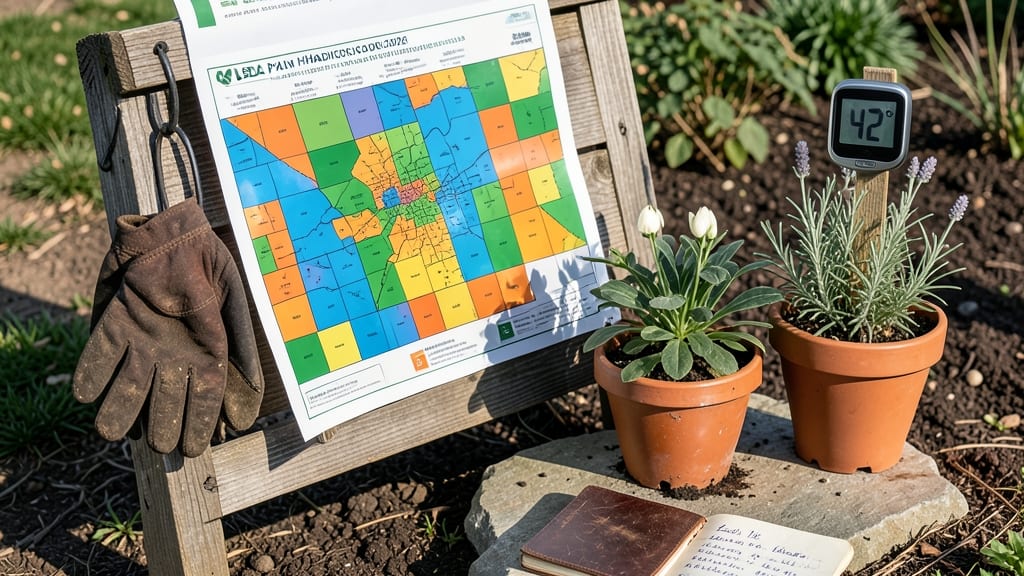
To determine your garden zone in 2025, use the updated USDA Plant Hardiness Zone Map, which classifies regions based on average annual minimum temperatures. Simply enter your ZIP code in the official USDA zone finder to pinpoint your exact zone (like Zone 5a or 10b) and plan your planting schedule with precision.
Finding your garden zone in 2025 matters because climate shifts are making these classifications more dynamic than ever. The USDA updates zones every 10 years based on long-term temperature data, and 2025's map reflects recent warming trends that could shift your zone by half a letter or more.
For example, areas that were once Zone 6 might now fall into Zone 7. This means your frost dates and last-frost averages may have changed too. 🌱 I always recommend double-checking with local weather records or gardening communities, as microclimates can create exceptions even within the same zone.
💡 In This Article
- How USDA Plant Hardiness Zones Are Updated for 2025
- Best Tools to Find Your 2025 Garden Zone Fast
How USDA plant hardiness zones are updated for 2025
The USDA updates its Plant Hardiness Zone Map every 10 years using 30 years of climate data from NOAA weather stations. For 2025, the latest data includes temperature records from 1991-2020, reflecting a 0.5-2°F warming trend compared to the previous 1981-2010 baseline.
This shift means many regions have moved into warmer zones—what was Zone 6a in 2012 might now be Zone 6b or 7a in 2025. 🌡️
Zones are determined by the average annual minimum temperature, measured at 5 feet above ground to account for microclimates. The map divides zones into 10-degree Fahrenheit bands (e.g., Zone 5 ranges from -20°F to -10°F), with "a" and "b" subzones representing 5°F increments.
For example, Zone 7b has average lows of 0°F to 5°F, while Zone 7a drops to -5°F to 0°F. These small differences drastically impact what plants survive.
Climate change accelerates these shifts. Since 1980, the contiguous U.S. has warmed by 1.7°F, pushing zones northward. In 2025, you might see Zone 8a (10°F to 15°F) where Zone 7b once stood. This affects frost dates too—areas now experience 1-2 weeks later first frosts than historical averages.
For gardeners, this means longer growing seasons but also new pest challenges as warmer climates favor invasive species. 🌿
Not all changes are uniform. Coastal areas warm faster due to ocean currents, while inland regions may see slower shifts. The USDA accounts for this by using thousands of weather stations and advanced modeling to smooth out local variations.
For instance, a city like Chicago (Zone 5b) might see its zone creep to Zone 6a by 2025, while rural areas nearby stay in Zone 5b due to cooler microclimates.
To verify your zone, cross-reference the USDA map with local frost records from your county extension office. For example, if the map says Zone 6a but your last frost is consistently April 15 (later than the zone’s average), you might extend your planting window.
This is why gardeners in transitional zones—like Zone 7b/8a borders—often experiment with heat-tolerant varieties to hedge their bets. 🌱
Understanding these updates helps you adapt. If your zone shifts upward, you can trial warmer-climate plants (e.g., citrus in Zone 8 instead of Zone 9) or adjust mulching strategies to protect tender crops.
The key is balancing the USDA’s broad strokes with your local observations—because no map replaces a decade of your own gardening notes.