
Advice
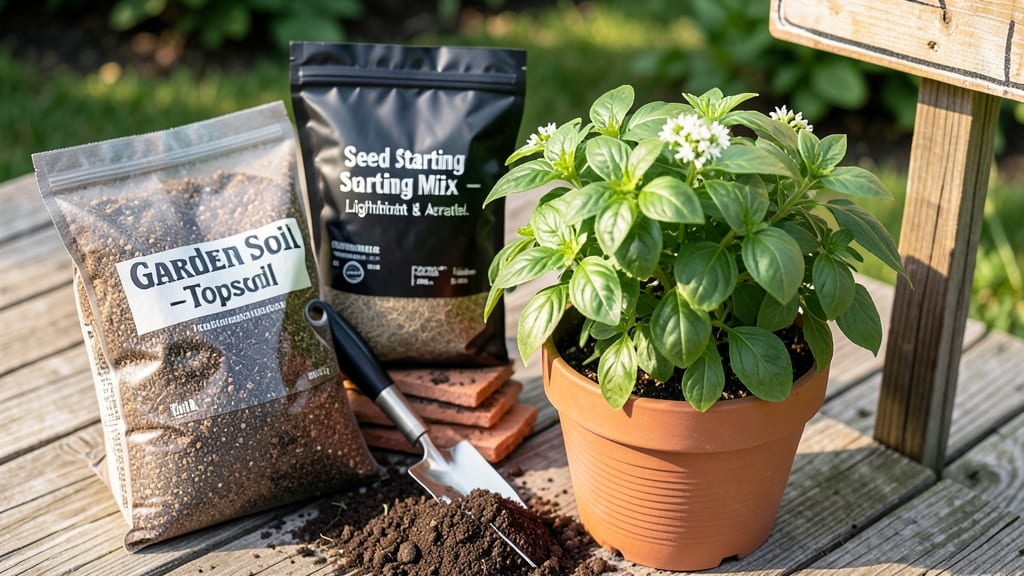
You can use garden soil for potting only after amending it with perlite, compost, and sand, since unmodified garden soil compacts too tightly, drains poorly, and often harbors pests or weeds. The right mix improves aeration and fertility for container plants.
Garden soil's heavy texture makes it ideal for in-ground planting, but its density suffocates roots in pots. 🌱 Without amendments, water pools at the bottom while upper layers dry out, creating anaerobic zones that rot roots.
I've seen even "good" garden soil fail when used straight from the yard—especially if it's clay-heavy or contains grass clippings that mat down. The solution is creating a 50-50 blend with coarse materials like perlite or vermiculite to prevent compaction while adding compost for microbial activity.
For best results, test your amended mix by squeezing a handful—it should crumble easily rather than hold shape. If you're working with contaminated soil (like from a construction site), skip it entirely and use store-bought potting mix instead.
The key is replicating the loose, well-draining structure of professional potting soil while keeping costs low for large containers.
💡 In This Article
- Why Garden Soil Fails in Potted Plants
- How to Safely Amend Garden Soil for Potting
Why garden soil fails in potted plants
Garden soil's natural structure makes it perfect for in-ground planting, but its dense composition becomes a liability in containers. The problem starts with compaction: when you water potted plants, the soil particles pack tightly together, leaving minimal air pockets.
This creates a suffocating environment where roots struggle to access oxygen—critical for growth. Compare this to ideal potting mix, which contains 25-30% air space by volume, allowing roots to breathe while still retaining moisture.
The water retention issue is equally problematic. Garden soil's fine particles hold water too tightly near the surface, while the bottom stays perpetually soggy. This creates what soil scientists call "anaerobic pockets"—zones where oxygen is completely absent.
Roots in these areas can't respire properly, leading to rot within 3-5 days of poor drainage. 🌱 Even drought-tolerant plants like succulents will suffer if planted in unamended garden soil, as their roots need that balance of quick-draining layers and moisture retention.
Nutrient availability becomes another major hurdle. Garden soil's organic matter breaks down slowly, releasing nutrients inconsistently. Potted plants, however, have limited root zones and exhaust nutrients faster. The microbial life in garden soil—while beneficial—often lacks the diversity found in specialized potting mixes, which are formulated to support rapid nutrient cycling.
This imbalance is why container-grown plants frequently show deficiencies like yellowing leaves (chlorosis) even when watered regularly.
Don't overlook the hidden dangers: garden soil often carries weed seeds, larvae, and pathogenic fungi that can thrive in the controlled environment of a pot. I've seen entire batches of seedlings lost to damping-off disease when planted in unsterilized garden soil.
The closed ecosystem of containers creates perfect conditions for these pests to multiply uncontrollably, unlike in open garden beds where natural predators help maintain balance.
Texture plays a surprising role too. Garden soil's particle size distribution—typically 40% sand, 40% silt, 20% clay—creates a cohesive mass when wet. In pots, this means water moves vertically rather than horizontally, starving roots in the middle of the container.
Professional potting mixes use coarse perlite or bark fines to create vertical channels that distribute water evenly throughout the root zone.
The root of the problem comes down to physics: containers restrict soil's ability to expand and contract with moisture changes. While garden soil can handle seasonal freeze-thaw cycles outdoors, potted plants experience daily temperature fluctuations that cause repeated expansion-contraction cycles.
This constant stress weakens soil structure over time, accelerating compaction. 💫