
Tools
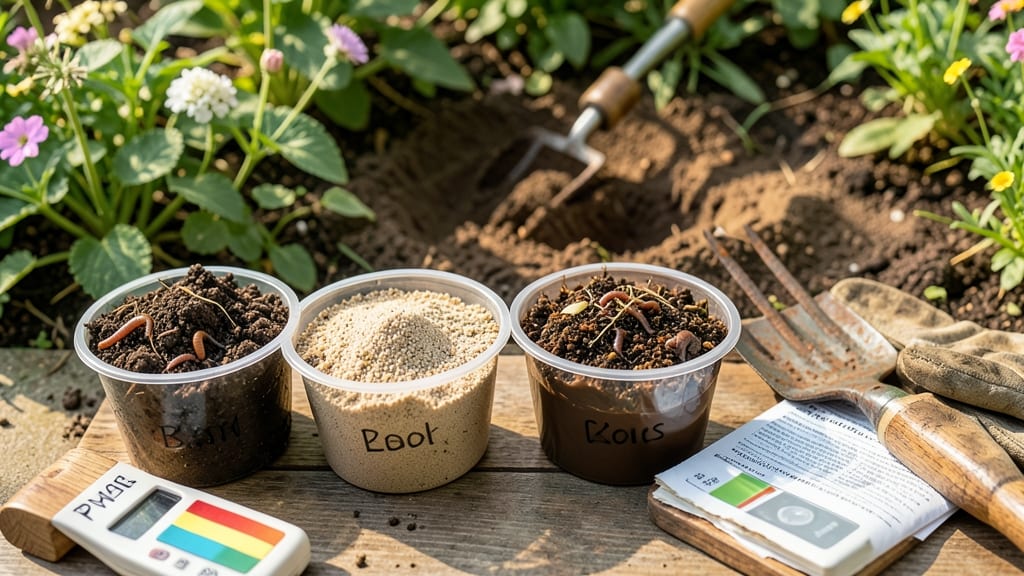
For garden beds, the best soil to use is loamy soil, which provides ideal drainage, aeration, and nutrient retention. Sandy soil drains too quickly, while clay holds too much moisture; improving most soil types with compost creates a balanced growing medium for healthy plants.
Loamy soil stands out because it combines the best qualities of sand, silt, and clay—about 40% sand, 40% silt, and 20% clay—creating a crumbly texture that roots love. 🌱 This structure allows water and air to reach plant roots while holding enough moisture to prevent drought stress.
If your soil leans too sandy, adding 2-3 inches of compost can transform it into a loam-like mix over time.
For gardeners starting with heavy clay or pure sand, I recommend testing your soil first. A simple jar test—fill a jar with soil, water, and shake—reveals the particle breakdown. Clay soils settle in layers, while sandy soils stay loose.
Mixing in organic matter like peat moss or coconut coir helps break up compacted clay, while perlite improves sandy soils' moisture retention.
💡 In This Article
- Understanding Soil Composition: Loam vs Sandy vs Clay for Plant Health
- DIY Soil Mixes for Garden Beds: Custom Blends for Different Plants
Understanding soil composition: loam vs sandy vs clay for plant health
Soil composition is all about particle size and how those particles interact with water, air, and nutrients. Loamy soil gets its perfect balance from roughly 40% sand, 40% silt, and 20% clay, creating a crumbly texture that holds moisture without drowning roots.
The sand particles (0.05-2mm) provide drainage channels, while the tiny clay particles (<0.002mm) hold nutrients and water like a sponge. Silt (0.002-0.05mm) bridges the gap, giving loam its ideal workability—neither too sticky nor too gritty.
Sandy soils drain water so quickly that nutrients wash away, while clay soils form dense clumps that suffocate roots by trapping too much water.
The difference comes down to pore space: sandy soils have large pores that drain fast but don't hold nutrients, while clay's tiny pores hold water but block air circulation.
Loam's magic lies in its macropores (for air/water movement) and micropores (for nutrient storage), creating a self-regulating system that mimics nature's forest floors. 🌱
Root health depends on this balance. In sandy soil, roots struggle to anchor and access nutrients, while clay's compacted structure restricts growth. Loam's structure allows roots to spread easily, accessing both water and oxygen.
The pH also matters—most plants thrive in slightly acidic to neutral soil (6.0-7.0), where nutrients like nitrogen, phosphorus, and potassium remain available. Clay soils often have higher pH, locking out essential minerals, while sandy soils may leach nutrients faster.
Consider your plants' needs: vegetables like tomatoes and peppers prefer loamy soil's fertility, while drought-resistant succulents thrive in sandy mixes. Heavy clay gardens benefit most from organic amendments like composted manure or leaf mold, which gradually break down clay particles over 1-2 years.
For sandy soils, adding 2-3 inches of compost annually helps retain moisture and nutrients without turning into mud.
Here's what happens when you get it wrong: overwatered clay soils lead to root rot, while dry sandy soils cause wilting despite frequent watering. The solution? Test your soil's texture by rubbing it between fingers—sandy feels gritty, clay is smooth and sticky, while loam crumbles easily.
For a quick fix, mix in 30% organic matter (compost, peat moss) to transform either extreme into something closer to loam. 💫