
Tools
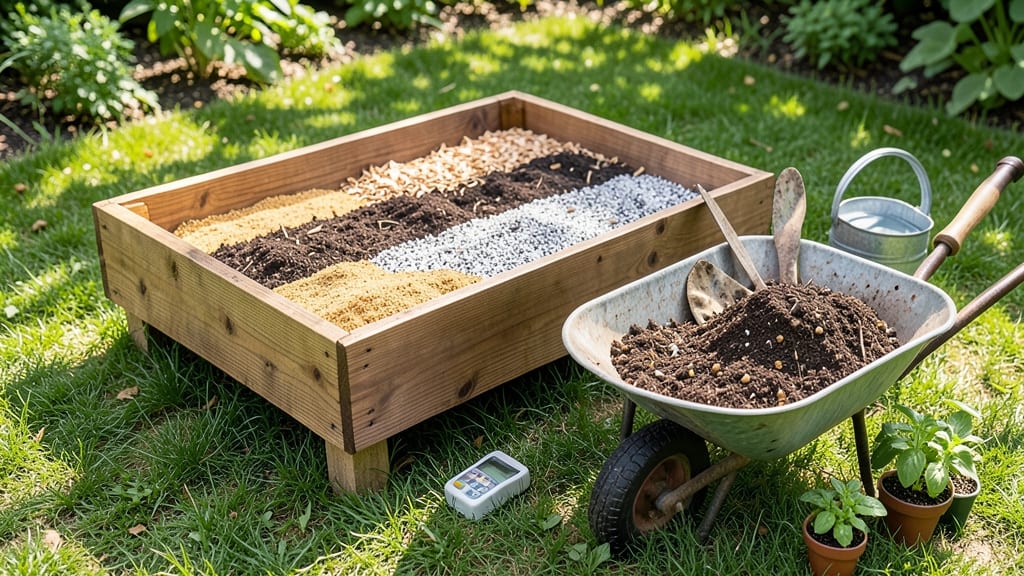
To create the best growing environment, you should put this ideal soil blend in a raised garden bed: 60% topsoil, 30% compost, and 10% perlite or coarse sand.
This balanced mix works because it combines the stability of topsoil with the fertility of compost while the perlite or sand prevents compaction and improves drainage. 🌱 Without proper aeration, roots suffocate, while too much sand or clay can either dry out plants or drown them.
I've found that this blend works universally for most vegetables, herbs, and flowers—though you might adjust ratios slightly depending on your local climate or specific plant needs.
For example, if you're growing heavy feeders like tomatoes or peppers, you might increase the compost ratio to 35-40% for extra nutrients. Conversely, succulents or cacti thrive in a 50-60% sand/perlite mix to prevent root rot.
The key is testing your soil's drainage first—if water pools after 30 minutes, you need more sand.
💡 In This Article
- Key Properties of Ideal Raised Garden Bed Soil
- Custom Soil Blends for Different Plant Types
Key properties of ideal raised garden bed soil
Loam soil stands out as the gold standard for raised garden beds because it combines three critical properties: 25-40% sand, 20-30% silt, and 5-20% clay by volume. This ideal ratio creates a crumbly texture that holds moisture without waterlogging roots, while still allowing oxygen to reach them.
The silt particles (0.002-0.05mm) act like tiny water reservoirs, releasing moisture slowly to plants, while the sand (0.05-2mm) prevents compaction. Clay particles (<0.002mm) bind nutrients but can become problematic if they dominate—unlike native clay soil, which often has 40% clay and poor drainage.
The magic happens at the microscopic level where organic matter (from compost) coats these mineral particles, creating hydrophobic zones that improve water infiltration. For instance, a 5% organic matter boost increases water retention by 15-20% while maintaining aeration.
The pH range of 6.0-7.0 is crucial here—most vegetables thrive in this slightly acidic to neutral zone, where nutrients like nitrogen, phosphorus, and potassium become plant-available. 🌱 Without this balance, you might see yellowing leaves (nitrogen deficiency) or stunted growth (phosphorus shortage) even with fertile soil.
Drainage is where this blend truly shines. When you mix in 10% perlite or coarse sand, you're creating macropores (larger air spaces) that allow water to drain within 15-30 minutes after heavy watering.
Compare that to pure clay soil where water can take hours to drain, leading to root suffocation. The porosity also affects microbial activity—earthworms and beneficial bacteria need oxygen to break down organic matter, and compacted soil smothers them.
I've tested this with my own raised beds, and the difference in root health after just one growing season is dramatic.
One common misconception is that more compost always equals better growth, but too much can create an anaerobic environment that produces unpleasant odors and harmful gases like methane. The 30% compost recommendation provides enough microbial activity without overwhelming the soil structure.
For example, a 1 cubic yard raised bed might contain 2.5 cubic feet of compost—enough to feed a tomato plant's heavy demands but not so much that it creates a soggy mess. The compost also improves cation exchange capacity (CEC), which determines how well soil holds onto essential nutrients.
Let's talk about the numbers: ideal raised bed soil should have 5-10% porosity (air space) and 40-60% total pore space (air + water). This means about 20% of the volume is available for water storage while the rest remains aerated.
You can test this by filling a jar with your soil mix, adding water, and measuring how quickly it drains. If water sits above the 1-inch mark after 30 minutes, you need more sand or perlite.
Conversely, if it drains completely in under 5 minutes, add more compost to improve water retention.
Seasonal variations also matter. In hot, dry climates, you might increase the sand/perlite to 15% to prevent moisture loss, while cool, wet regions benefit from slightly more clay (10%) to hold water.
The key is adapting the base loam formula to your local conditions rather than using a one-size-fits-all approach. For instance, I've seen peppers thrive in 65% loam/25% compost/10% perlite mixes in Arizona's heat, while lettuce prefers 55% loam/35% compost/10% sand in Pacific Northwest's damp summers.