
Tools
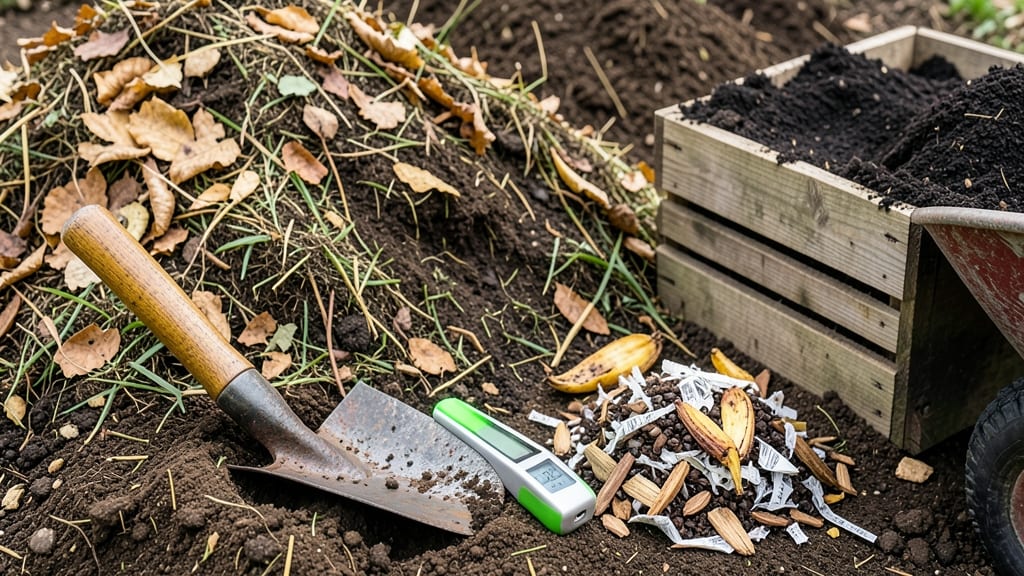
Garden compost is decomposed organic matter—like yard waste, food scraps, and plant clippings—that enriches soil with nutrients, improves drainage, and promotes beneficial microbial activity for healthier plants. It differs from mulch or fertilizer by being a slow-release, nutrient-dense soil amendment rather than a surface cover or chemical additive.
Garden compost works like nature's recycling system, breaking down organic materials into a nutrient-rich soil amendment. 🌱 Unlike synthetic fertilizers that provide quick but temporary nutrients, compost gradually releases essential minerals while improving soil structure and water retention.
Think of it as a long-term investment for your garden—it feeds plants, supports beneficial microbes, and creates a thriving ecosystem beneath the surface.
This organic material transforms kitchen scraps, yard waste, and plant debris into a dark, crumbly substance packed with carbon, nitrogen, and trace minerals. The decomposition process not only reduces landfill waste but also creates a sustainable soil conditioner that many gardeners consider essential for healthy plant growth.
Unlike mulch, which primarily conserves moisture and suppresses weeds, compost actively improves soil fertility.
💡 In This Article
- How Garden Compost Enhances Soil Health
- Compost vs Mulch vs Fertilizer: Key Differences
How garden compost enhances soil health
At its core, garden compost creates a thriving microbial ecosystem that actively recycles nutrients. When organic materials like fruit peels, grass clippings, and fallen leaves decompose, they feed billions of bacteria, fungi, and earthworms that break down complex compounds into plant-available forms.
This process converts nitrogen (N), phosphorus (P), and potassium (K)—the primary plant nutrients—into bioavailable forms through enzymatic reactions.
For example, a well-balanced compost pile can contain up to 2-3% nitrogen, 0.5-1% phosphorus, and 1-2% potassium by weight, which are gradually released over months rather than weeks like synthetic fertilizers.
The physical transformation is equally impressive. As organic matter decomposes, it creates a porous, crumbly structure that improves soil aeration by up to 30-50% compared to compacted clay soils. This structure also enhances water retention—compost can hold 3-4 times its weight in water—while preventing waterlogging by improving drainage.
The dark, earthy aroma you notice when turning a compost pile comes from volatile organic compounds released during microbial activity, signaling active nutrient cycling. Unlike peat moss, which is harvested from fragile ecosystems, compost is locally renewable and contains beneficial mycorrhizal fungi that form symbiotic relationships with plant roots.
What makes compost truly unique is its slow-release mechanism. Synthetic fertilizers deliver nutrients in highly concentrated forms that plants can absorb quickly, but this often leads to nutrient runoff and soil acidification. Compost, however, releases nutrients at a rate that matches plant uptake, reducing waste and supporting long-term soil fertility.
For instance, a single application of compost can provide nutrients for 6 months to 2 years, depending on soil conditions and plant types. This gradual release also prevents the "burn" effect that often occurs with chemical fertilizers, where excess salts damage plant roots.
Consider the case of vegetable gardens: plants grown in compost-amended soil show 20-30% higher yields and better resistance to pests and diseases. The reason? Compost strengthens plant immune systems by enhancing beneficial microbial populations that outcompete pathogens.
For example, a study by the Rodale Institute found that compost-treated soils had 30% more beneficial bacteria and 40% more fungi compared to chemically fertilized soils. This microbial diversity creates a resilient ecosystem that supports plant health beyond just nutrient supply.
The visual difference is striking too. Fresh compost has a dark brown to black appearance with a crumbly texture resembling fine, damp potting soil. When mixed into garden beds, it creates a rich, loamy texture that's ideal for root development.
Unlike peat moss—which is sterile and lacks microbial activity—compost introduces living organisms that actively improve soil structure. For gardeners, this means healthier plants with stronger root systems that can access nutrients more efficiently, even in challenging conditions like heavy clay or sandy soils.
What most people don't realize is how compost affects soil pH over time. While it's slightly acidic when fresh (pH 6.0-7.0), it naturally buffers soil pH by providing organic acids and alkaline minerals.
This makes it particularly valuable for acidic soils, where it can gradually raise pH levels without the need for lime amendments. The long-term benefits extend to water quality too—compost-amended soils absorb and retain rainwater more effectively, reducing runoff that carries pollutants into waterways.