
Tools
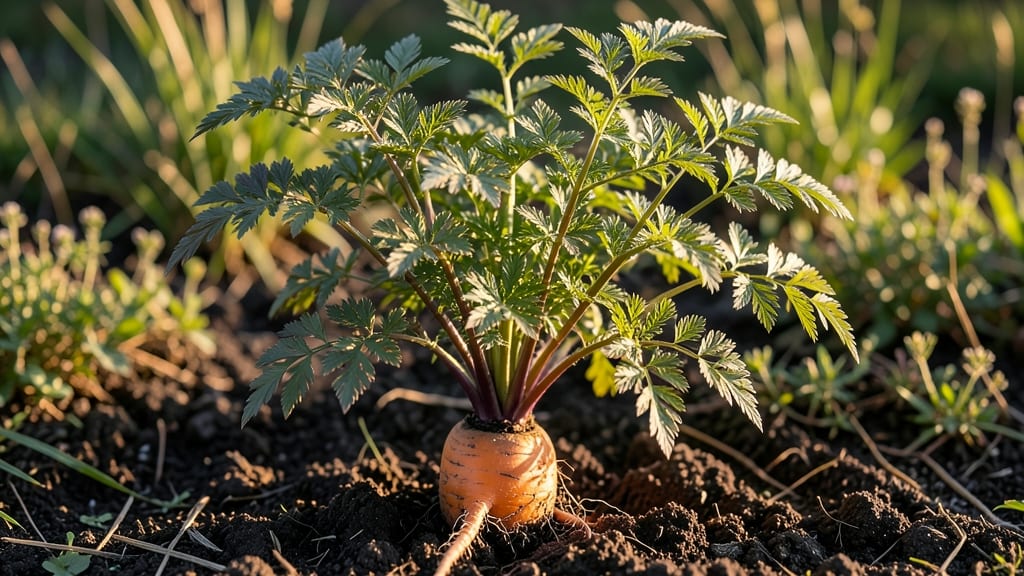
Carrot tops in the garden look like delicate, fern-like foliage with finely textured green leaves arranged in a tight circular pattern just above the soil. These leafy greens typically grow 6-12 inches tall, forming a dense, low canopy that spreads outward from the central stem.
Carrot tops develop through distinct stages, starting as tiny seedling leaves that gradually unfurl into their signature lacy, compound structure. 🌱 The young leaves appear almost translucent before maturing into deeper greens, with each leaf divided into numerous slender segments.
This growth pattern helps them efficiently capture sunlight while staying close to the ground, a key adaptation for their shallow root system.
One of the most distinctive features is how the leaves form a perfect rosette pattern, creating a dense mat that helps conserve moisture.
Unlike many garden weeds, carrot tops maintain this organized growth habit throughout their life cycle, making them easy to identify once you know what to look for in your garden beds.
💡 In This Article
- Identifying Carrot Leaf Stages from Seedling to Maturity
- Carrot Top vs. Weed: Key Differences for Gardeners
Identifying carrot leaf stages from seedling to maturity
The journey of carrot tops begins with the cotyledon stage, where the first leaves appear as tiny, rounded, and slightly heart-shaped structures just above the soil. These seed leaves are typically 0.5-1 inch wide and have a smooth, waxy texture that helps protect the young plant from dehydration.
Within 1-2 weeks under ideal conditions (consistent moisture and 60-75°F temperatures), these cotyledons unfurl to reveal the first true leaves, which are the signature lacy, compound structures.
At this seedling stage, the true leaves emerge in a whorl pattern, each divided into 3-5 slender segments that resemble delicate fern fronds. These early leaves are often a lighter green, almost blue-green hue, due to high chlorophyll content that maximizes sunlight absorption.
The plant's growth rate accelerates when exposed to full sun (6-8 hours daily), with leaves developing a more robust structure and darker coloration as they mature into the vegetative stage.
During the mature foliage phase, carrot tops reach their full 6-12 inch height, forming a dense rosette that can spread 12-18 inches wide depending on variety.
The leaves at this stage develop a deep green to purple-green coloration, with each compound leaf divided into 5-9 finely serrated segments.
This intricate structure increases the leaf's surface area by up to 30% compared to simple leaves, allowing for more efficient photosynthesis while staying close to the soil to conserve moisture.
Environmental factors play a crucial role in leaf development. In low-light conditions, carrot tops may grow taller and more spindly with lighter-colored leaves, while high temperatures above 85°F can cause leaves to become thicker and more waxy as a protective measure.
Nutrient availability also affects leaf shape—phosphorus deficiency often results in dark green leaves with purple undersides, while nitrogen deficiency produces pale, stunted growth. 🌿
One fascinating adaptation is how carrot tops grow in a determinate pattern, meaning all leaves emerge from the central stem simultaneously rather than sequentially. This creates the characteristic circular rosette that distinguishes them from many weeds.
The leaf arrangement also helps channel water and nutrients directly to the developing carrot root below, demonstrating nature's efficient design for maximizing growth resources.
For gardeners, recognizing these stages helps time harvests effectively. Young leaves (3-4 weeks old) are tender and best for salads, while mature leaves (6-8 weeks) are more robust for cooking.
The transition from seedling to maturity typically takes 4-6 weeks in optimal conditions, though cooler temperatures can extend this period by 2-3 weeks.