
Tools
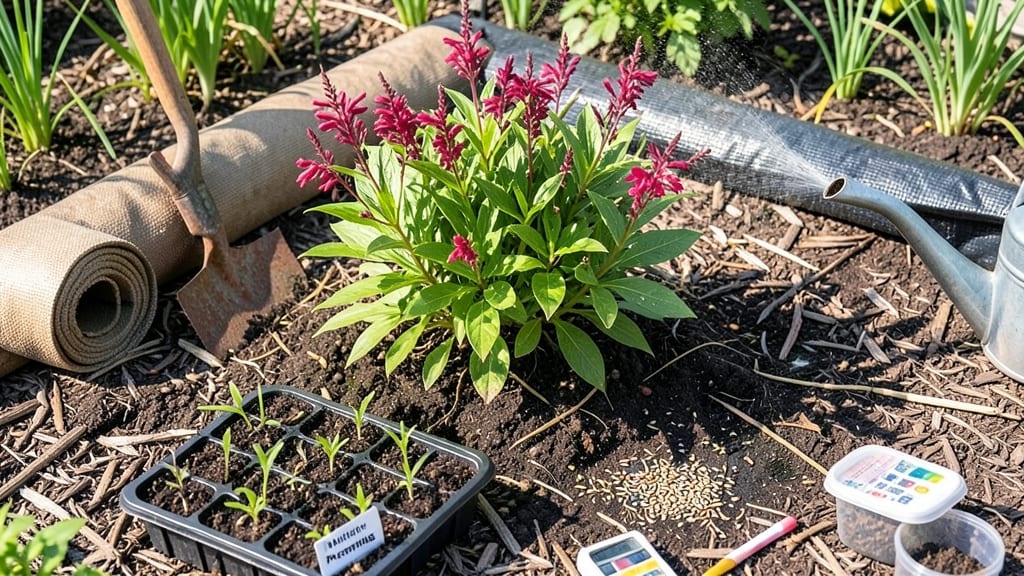
A rain garden soil mix should combine 40% native topsoil, 30% compost, 20% coarse sand, and 10% perlite or peat moss to balance drainage and moisture retention for plants like irises and sedges.
This blend works because the native soil provides essential microbes and nutrients, while compost enriches it with organic matter that holds water without suffocating roots. 🌱 The coarse sand prevents compaction, creating air pockets that help roots breathe, and perlite or peat moss adds structure to prevent clumping.
I've found that adjusting the sand ratio slightly—up to 25%—helps in clay-heavy soils, while adding more compost (up to 40%) benefits sandy soils that dry out too quickly.
For best results, mix these ingredients thoroughly in a wheelbarrow or large container before spreading the soil. Test your mix by pouring water over it: if it drains within 15-30 minutes but doesn't puddle, you've got the right balance.
This approach ensures your rain garden thrives by mimicking natural wetland conditions while preventing waterlogging or erosion.
💡 In This Article
- How Soil Composition Affects Rain Garden Drainage and Plant Growth
- Step-by-Step Guide to Mixing and Layering Rain Garden Soil
How soil composition affects rain garden drainage and plant growth
The foundation of any successful rain garden begins with understanding how each soil component interacts to create the perfect balance. Native topsoil—typically making up 40% of your mix—provides the essential microbial community that breaks down organic matter and supplies nutrients to plants.
These microbes thrive in the natural environment where your soil was sourced, creating a symbiotic relationship with plant roots that store nutrients in their tissues for slow release.
Without this native soil base, your garden would lack the biological activity needed to sustain long-term plant health, especially for deep-rooted species like irises or joe-pye weed.
Compost, which should comprise 30% of your mix, acts as the soil's water reservoir while improving its structure. When you add well-aged compost, you're introducing humus—a dark, spongy material that can hold 20 times its weight in water while still allowing excess to drain.
This moisture retention is critical because rain gardens experience fluctuating water levels; too little compost (under 20%) risks poor water retention, while too much (over 40%) can lead to anaerobic conditions that suffocate roots.
The ideal compost also contains 1-3% nitrogen, which feeds microbial activity and prevents that "new soil" smell that deters wildlife.
Coarse sand plays a dual role in your mix by preventing compaction and improving aeration. When you incorporate 20% sand with particles ranging from 0.5-2mm in diameter, you create air pockets that allow oxygen to reach roots—a necessity for plants that experience both wet and dry periods.
The sand also helps break up clay particles in heavy soils, preventing that dense, brick-like consistency that strangles roots. I've noticed that using sharp-edged sand (like masonry sand) works better than smooth river sand because the rough texture creates more stable pore spaces over time.
Perlite or peat moss, which make up the final 10%, serve as structural stabilizers that prevent your soil from clumping.
Perlite, a volcanic glass, expands when heated to create lightweight, porous particles that improve drainage, while peat moss adds acidity (pH 3.5-4.5) that benefits plants like blue flag irises or cattails.
The key difference is that perlite is inorganic and won't decompose, making it ideal for long-term projects, whereas peat moss breaks down over 10-15 years and needs replenishing. Together, these components create a soil matrix that mimics the natural wetland conditions rain gardens thrive in.
What most people overlook is how these components work together to create what soil scientists call "hydraulic conductivity"—the soil's ability to transmit water. A well-balanced mix achieves a drainage rate of 0.5-2 inches per hour, which is perfect for rain gardens.
Too much sand (over 25%) can create a "flashy" soil that drains too quickly, while too little (under 15%) leads to waterlogging. The sweet spot occurs when the organic matter and sand work in harmony to create capillary action that pulls water upward while allowing excess to drain downward.
For visual learners, imagine your rain garden soil as a sponge with different layers: the compost acts as the thick, water-absorbing middle layer, while the sand and perlite create the fine pores that regulate flow.
This structure is why native plants like swamp milkweed or pennywort flourish—they've evolved to handle these precise moisture conditions. The native soil provides the biological foundation, while the amendments create the physical environment that supports root health and nutrient uptake.