
Tools
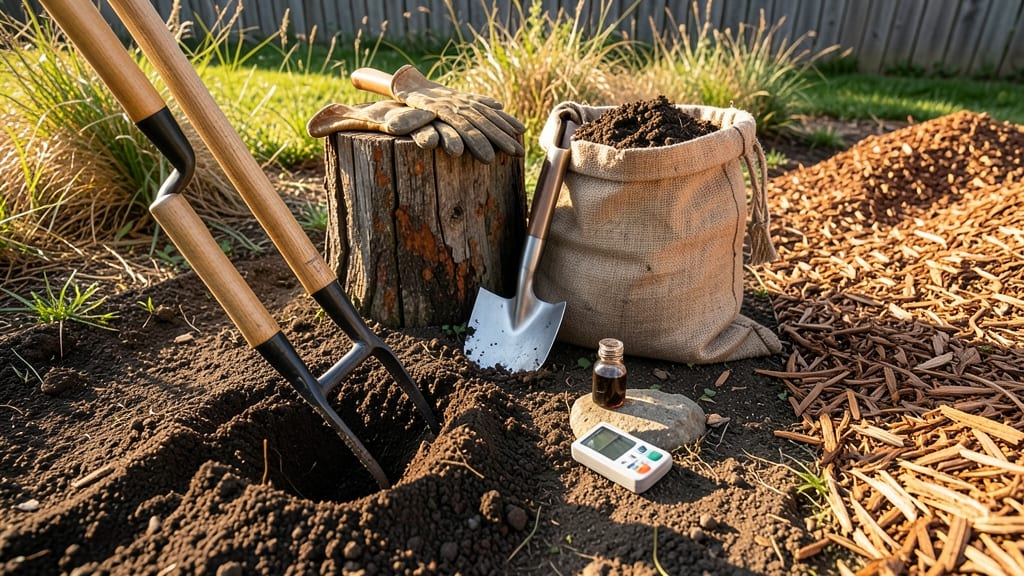
To prepare soil for a flower garden, you'll need to test pH levels, clear away debris, aerate compacted earth, and enrich with compost or organic matter to create ideal drainage and nutrient conditions for thriving plants.
Great flower beds start with healthy soil that supports strong root systems and vibrant blooms. 🌸 Testing your soil's pH (aim for 6.0-7.0 for most flowers) reveals whether your plants will thrive or struggle—acidic or alkaline conditions can stunt growth.
I always recommend using a simple home test kit first, then adjusting with lime (for acidic soil) or sulfur (for alkaline soil) if needed.
Beyond pH, breaking up compacted earth with a garden fork improves airflow to roots, while adding aged compost or coconut coir boosts moisture retention and microbial activity.
Don't overlook the importance of proper drainage—waterlogged soil suffocates roots just as much as dry, hardpan does. Mixing in 1-2 inches of organic matter like worm castings or leaf mold creates a loamy texture that holds nutrients while allowing excess water to escape.
For heavy clay soils, incorporate sand or perlite to lighten the mix, while sandy soils benefit from peat moss or compost to improve water retention. Timing matters too: prepare your soil in early spring or fall when temperatures are mild and rainfall is consistent.
💡 In This Article
- How to Test and Improve Flower Garden Soil Quality
- Essential Tools and Materials for Soil Preparation
How to test and improve flower garden soil quality
Soil testing reveals the hidden world beneath your garden—where pH, texture, and nutrient levels determine whether your flowers will thrive or struggle. Start with a simple pH test kit, which uses color-changing indicators to measure acidity or alkalinity on a scale from 0-14.
Most flowers prefer a neutral range of 6.0-7.0, but blueberries (acid-loving) need 4.5-5.5 while lilacs (alkaline-tolerant) can handle up to 7.5. The test works by reacting soil samples with a chemical solution that changes color—compare it to the kit's chart for precise readings.
Texture matters just as much as chemistry. Grab a handful of damp soil and squeeze it—does it crumble easily (sandy), form a loose ball that breaks apart (loamy), or hold together tightly (clay)? Sandy soils drain too quickly, while clay holds water like a sponge.
The ideal loamy soil combines sand, silt, and clay in equal parts, creating a crumbly texture that retains moisture without suffocating roots.
For heavy clay, mix in 2-3 inches of compost per square foot to improve aeration, while sandy soils benefit from peat moss or coconut coir to boost water retention.
Nutrient analysis often gets overlooked, but it's crucial for vibrant blooms. A comprehensive soil test (available through extension services) checks for nitrogen (leaf growth), phosphorus (root development), and potassium (flower production). Many garden soils lack these essentials—especially phosphorus, which plants can't access easily in cold or alkaline conditions.
If your test reveals deficiencies, amend with bone meal (3-4 pounds per 100 sq ft) for phosphorus or kelp meal for potassium. 🌱 These organic amendments release nutrients gradually, feeding plants over time rather than causing sudden spikes that burn roots.
Poor drainage is another silent killer of flower gardens. Waterlogged soil cuts off oxygen to roots, leading to rot and disease. To test drainage, dig a 12-inch deep hole and fill it with water—if it drains in under 2 hours, your soil is fine.
If water remains after 6 hours, you need to improve drainage by adding coarse sand or perlite (up to 20% of the soil volume) to create air pockets.
For container gardens, ensure pots have drainage holes and use a mix of 50% potting soil, 30% perlite, and 20% compost to prevent compaction.
Seasonal timing affects how well amendments integrate into your soil. Work organic matter into the top 6-12 inches of soil in early spring or fall when temperatures are mild and rainfall helps distribute nutrients. Avoid tilling when soil is wet—this creates clumps that compact over time.
Instead, use a broadfork to loosen soil without disrupting the natural structure. For established gardens, top-dress with 1-2 inches of compost annually to maintain fertility without heavy disturbance.
What most gardeners don't realize is how microbial activity transforms soil quality. Healthy soil teems with bacteria, fungi, and earthworms that break down organic matter into plant-available nutrients.
To boost this ecosystem, add worm castings (1 cup per sq ft) or mycorrhizal fungi, which form symbiotic relationships with plant roots.
These microscopic helpers improve nutrient uptake by up to 80%—meaning your flowers get more from the same soil. 🌿 The key is consistency: regular amendments create a self-sustaining cycle where soil improves year after year.