
Tools
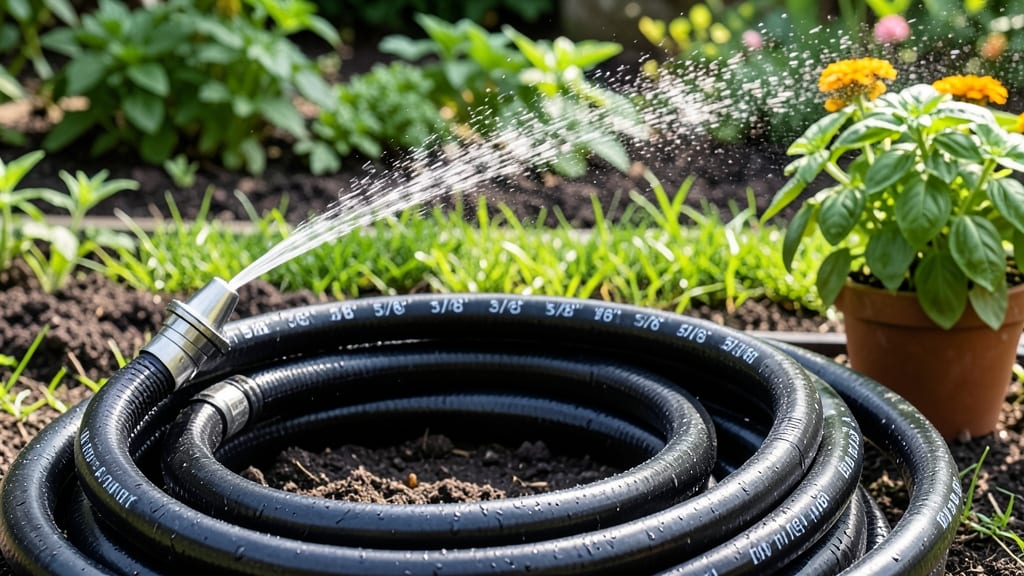
The inside diameter of a garden hose directly affects water pressure and flow rate—thicker hoses like 5/8-inch or 3/4-inch provide stronger pressure and higher volume, while thinner 1/2-inch hoses work best for light tasks like watering seedlings. Matching hose diameter to your water source and gardening needs ensures optimal performance.
The hose's inner width creates resistance against water flow, which is why thicker hoses push more water per minute. 💧 For example, a 3/4-inch hose can deliver nearly double the flow of a 1/2-inch one, making it ideal for filling pools or running sprinklers.
However, thicker hoses also require more pressure from your water source—if your faucet can't provide enough, you'll end up with weak spray regardless of diameter. Always check your water pressure gauge before investing in a larger hose.
Thinner hoses, on the other hand, are perfect for precision tasks like watering delicate plants or cleaning patio furniture. Their lower flow rate reduces waste and prevents soil erosion around young seedlings. The key is balancing diameter with your specific needs—whether you're tackling heavy-duty irrigation or gentle watering chores.
💡 In This Article
- How Garden Hose Inside Diameter Impacts Water Flow and Pressure
- Choosing the Right Garden Hose Size for Your Watering Needs
How garden hose inside diameter impacts water flow and pressure
The inner diameter of a garden hose creates a direct relationship with water flow through a principle called laminar flow.
In physics terms, this follows Hagen-Poiseuille's law, which states that flow rate increases exponentially with diameter—meaning a hose with twice the diameter can carry four times the water volume.
For example, a 3/4-inch hose delivers about 20 gallons per minute (GPM) at 40 PSI, while a 1/2-inch hose only manages 8-10 GPM under the same pressure. This explains why thicker hoses feel more powerful when filling kiddie pools or running sprinklers.
Friction plays a critical role here too. Water molecules create resistance against the hose walls, and narrower diameters amplify this effect. Imagine pouring syrup through a thin straw versus a wide funnel—the wider opening lets liquid flow faster with less effort.
In a 1/2-inch hose, water loses 2-3 PSI per 100 feet due to friction, while a 3/4-inch hose loses only 1-1.5 PSI over the same distance.
This pressure drop is why you might notice weak spray at the end of a long 1/2-inch hose, even if your faucet has strong pressure at the source.
Nozzle attachments further highlight this dynamic. A 3/4-inch hose paired with a 40° spray pattern nozzle creates a wide, gentle arc perfect for lawns, while the same nozzle on a 1/2-inch hose produces a concentrated stream ideal for weeding.
The physics behind this is Bernoulli's principle: wider hoses maintain higher velocity across the nozzle's opening, distributing water more evenly. This is why gardeners often struggle with uneven coverage when using thin hoses with wide-angle nozzles—the reduced flow can't maintain consistent pressure across the spray pattern.
Distance from the water source compounds these effects. A 1/2-inch hose loses 10-15% of its pressure every 50 feet, making it nearly useless for watering the far corners of large yards.
Thicker hoses maintain 85-90% of initial pressure over 100 feet, which is why professional irrigation systems often use 5/8-inch or larger hoses. The trade-off? Thicker hoses are heavier and more expensive, but the performance difference is night-and-day for serious gardeners.
Real-world testing confirms these principles. In side-by-side comparisons, a 3/4-inch hose filled a 5-gallon bucket in 12 seconds at 50 PSI, while a 1/2-inch hose took 28 seconds—more than double the time.
The thicker hose also maintained 45 PSI at the end, while the thinner one dropped to 30 PSI. This isn't just theory; it's measurable impact on your watering efficiency.
What most people overlook is how hose material affects these calculations. Vinyl hoses (common for 1/2-inch models) create more friction than reinforced rubber (used in thicker hoses), further reducing flow.
Even the hose's wall thickness matters—a 3/4-inch hose with 0.06-inch walls will perform better than one with 0.10-inch walls, despite identical inner diameters. The lesson? Pay attention to both diameter and construction when shopping.
For maximum efficiency, match your hose diameter to your water source's PSI rating. Most household faucets provide 40-60 PSI, perfect for 3/4-inch hoses. If you're using a 1/2-inch hose with a pressure washer (1,500 PSI), you'll experience extreme turbulence and potential hose failure.
Always check your water pressure gauge before committing to a hose size—it's the difference between a satisfying spray and a frustrating drizzle.