
Light Requirements
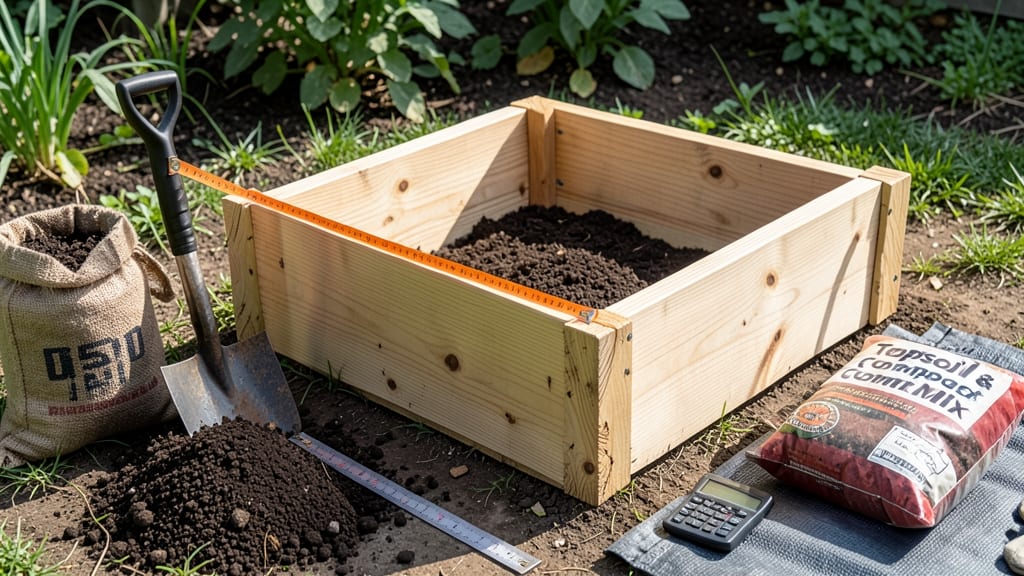
To calculate how much soil you need for a raised garden bed, multiply the bed’s length by width by depth (in feet), then divide by 27 to convert cubic feet to cubic yards. A 4’x8’ bed filled 12” deep needs about 3.5 cubic yards.
This formula works because garden soil is sold by volume, and most suppliers measure in cubic yards. 🌱 For instance, if your bed is 6’x4’ and you want 18” of soil depth, you’d multiply 6 × 4 × 1.5 (converting 18” to feet) to get 36 cubic feet—then divide by 27 to find you need 1.33 cubic yards.
Always round up slightly to account for settling, especially with heavier soils like clay.
Pro tip: Check your soil supplier’s recommendations—they often suggest adding compost or perlite to improve drainage and fertility. This can slightly increase your total volume needs, so plan accordingly. For deeper beds (18”+), consider layering different soil types to optimize root growth and moisture retention.
💡 In This Article
- Calculating Raised Garden Bed Soil Volume: Step-by-Step Formula
- Best Soil Types and Mixes for Raised Garden Beds
Calculating raised garden bed soil volume: step-by-step formula
The core of calculating soil volume lies in understanding three dimensions: length, width, and depth. First, measure your bed's length and width in feet—most beds use whole numbers like 4’x8’ or 6’x4’.
For depth, convert inches to feet by dividing by 12 (e.g., 12" = 1 foot, 18" = 1.5 feet).
This conversion is critical because soil suppliers measure in cubic feet and yards, not inches. 🌱 For example, a 4’x8’ bed with 18" depth becomes 4 × 8 × 1.5 = 48 cubic feet.
Next, multiply these three numbers to get cubic feet. This step accounts for the actual space soil will occupy. The formula works because volume is always length × width × height. For a 6’x4’ bed with 18" depth, you’d calculate 6 × 4 × 1.5 = 36 cubic feet.
What most people overlook is that soil settles over time—especially loamy or clay-heavy mixes—which can reduce volume by 10-20%. To compensate, add 10% to your cubic feet total before converting to cubic yards.
The conversion to cubic yards happens by dividing cubic feet by 27 (since 1 cubic yard = 27 cubic feet). Using our 36 cubic feet example, 36 ÷ 27 = 1.33 cubic yards. Round up to 1.5 cubic yards to account for settling and supplier measurement tolerances.
This adjustment ensures you won’t run short mid-project. For deeper beds (18"+), consider layering soil types—like a 6" compost layer over topsoil—to improve drainage and fertility while maintaining accurate volume calculations.
Real-world adjustments matter too. For instance, a bag of "topsoil" labeled as 1 cubic yard might actually contain only 0.8 cubic yards when loosened in your bed. Always check with suppliers about their "loose fill" versus "compacted" volume measurements.
A 4’x8’ bed at 12" depth would need 3.5 cubic yards of loose fill soil, but if using pre-mixed raised bed blends (which are often more compact), you might need closer to 4 cubic yards. This precision prevents costly last-minute trips to the garden center.
Visualizing the math helps: imagine your bed as a rectangular box. The deeper the box (height), the more soil it holds. A 4’x8’ bed at 12" depth holds 32 cubic feet (4 × 8 × 1), while the same bed at 18" depth jumps to 48 cubic feet.
This 50% increase shows why depth choices significantly impact material costs. For tall beds (24"+), consider using lighter amendments like perlite or coconut coir to reduce weight and improve aeration without sacrificing volume.
Pro tip: Use a soil calculator tool to double-check your math. These tools often include built-in adjustments for settling and amendments. For example, adding 20% compost to your mix might increase total volume needs by 5-10%.
Always verify with your supplier’s recommendations—they may suggest specific blends that alter the standard cubic yard calculations.