
Container Gardens
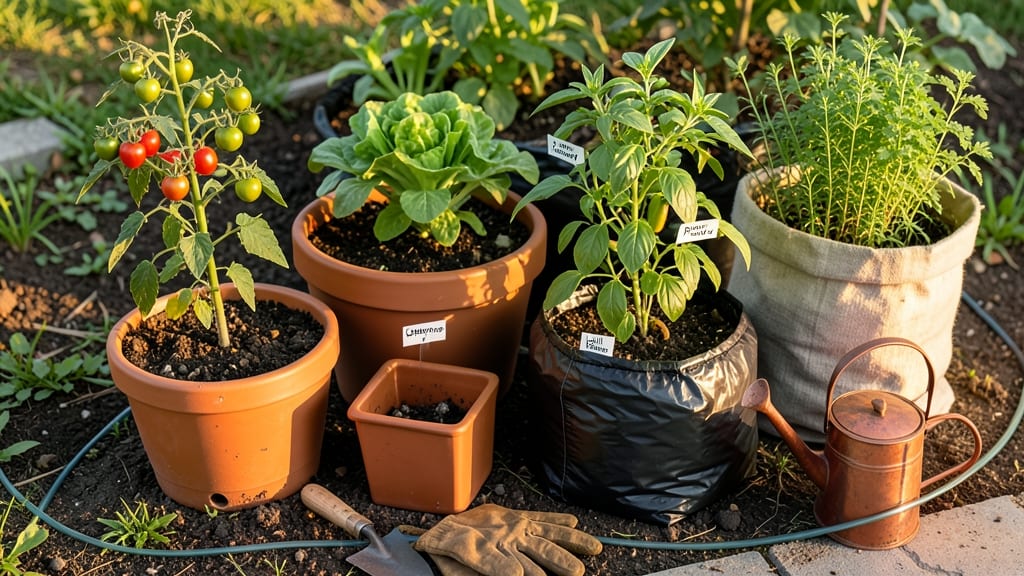
Growing a vegetable garden in pots lets you cultivate compact, fast-growing plants like cherry tomatoes, leafy greens, and radishes in containers with proper drainage and sunlight exposure.
Container gardening transforms small spaces into productive growing areas by focusing on plants that thrive in limited root zones. 🌱 The key is choosing varieties bred for pots—like bush beans, dwarf peppers, or salad greens—which mature quickly and don't outgrow their containers.
I've found that adding a slow-release fertilizer at planting time gives these plants the nutrients they need without overwhelming their confined roots. Proper drainage is non-negotiable: without it, even the hardiest plants will suffer from root rot in just days.
Another game-changer is container material—terracotta breathes but dries faster, while plastic retains moisture longer. For maximum efficiency, I recommend using self-watering pots for leafy greens, which help maintain consistent soil moisture without the risk of overwatering.
The right soil mix (60% potting soil, 30% compost, 10% perlite) creates the perfect balance of aeration and nutrient retention for container-grown vegetables.
💡 In This Article
- Best Vegetable Varieties for Container Gardening
- Container Selection and Soil Essentials for Potted Vegetables
Best vegetable varieties for container gardening
Container gardening succeeds because it focuses on plants with shallow root systems and rapid growth cycles. The best candidates are those whose mature root zones fit comfortably in 5- to 12-inch-deep pots.
For example, radishes reach maturity in just 25-30 days with roots only 1-2 inches deep, making them ideal for 6-inch-deep containers. Lettuce varieties like 'Buttercrunch' or 'Leaf Lettuce' thrive in shallow pots too, growing to 12-18 inches tall with minimal root spread—perfect for balcony railing planters.
Tomatoes are container gardening superstars when you choose the right varieties. Cherry tomatoes like 'Tiny Tim' or 'Patio Princess' produce abundant fruit in 5-gallon containers, while their indeterminate cousins need 10+ gallons to support their sprawling vines.
The key difference is growth habit: determinate (bush) types stop growing at 3-4 feet, while indeterminate varieties keep growing until frost. 🌿 Peppers also adapt well—'Jalapeño M' and 'Shishito' stay compact at 2-3 feet tall, fitting neatly in 1-gallon pots each.
Vertical space is your ally in container gardens. Pole beans like 'Kentucky Wonder' or 'Blue Lake' climb 5-6 feet on trellises but have roots that stay shallow, making them perfect for 12-inch-deep containers with support.
Herbs like basil, thyme, and parsley also excel in pots—their aromatic leaves develop more intensely when their roots are confined, and they rarely exceed 18 inches in height.
Even carrots can work in containers if you choose short varieties like 'Paris Market' (only 4-5 inches long) and use deep 12-inch pots with loose, sandy soil.
Sunlight requirements vary dramatically between varieties, which is why placement matters. Leafy greens like spinach and kale tolerate 4-6 hours of sun daily, while tomatoes and peppers demand 6-8+ hours of full sun.
The difference shows up in flavor and yield: a tomato plant in partial shade might produce half the fruit of one in full sun, and the flavor will be milder. 🌞 For example, 'Sun Gold' cherry tomatoes need 8+ hours of direct sunlight to ripen properly, while 'Red Sails' lettuce thrives with just 4-5 hours of morning sun.
Consider companion planting to maximize your container garden's efficiency. For instance, pairing basil with tomatoes repels pests and enhances flavor, while marigolds planted alongside peppers deter aphids. The root competition between compatible plants actually improves growth—shallow-rooted herbs like chives won't compete with deeper-rooted tomatoes.
This strategic pairing lets you grow 2-3 compatible plants in a single 5-gallon container without sacrificing yields.
One common mistake is choosing varieties based solely on appearance rather than growth habit. For example, 'Beefsteak' tomatoes look impressive but need 20+ gallons of space—far more than most balconies can provide.
Instead, opt for 'Tiny Tim' or 'Micro Tom', which produce abundant fruit in 5-gallon pots while staying under 2 feet tall. The same principle applies to squash: 'Eight Ball' zucchini stays compact at 1-2 feet wide, while traditional varieties sprawl 3-5 feet.