
Tools
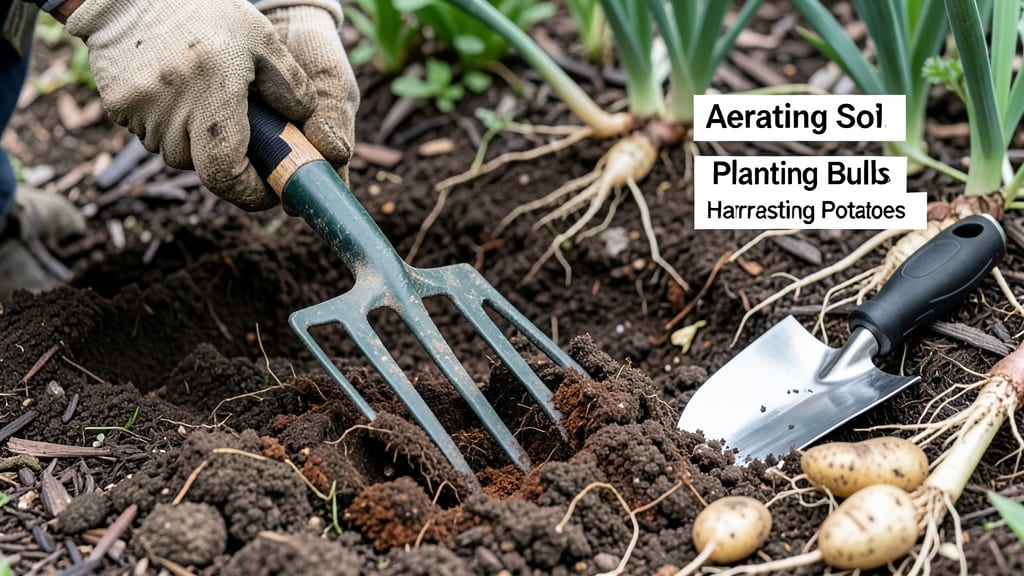
A garden fork's versatile uses go far beyond digging—it aerates soil, lifts sod, mixes compost, and even extracts weeds with roots intact. Its sturdy tines make it ideal for breaking up hardpan, turning compost piles, and prying out stubborn rocks without damaging plants.
A garden fork’s four sturdy tines are designed to tackle problems most tools can’t. Unlike a spade, which slices cleanly, this fork’s prongs lift and loosen soil without tearing roots—perfect for transplanting or moving sod. 🔥 The wide spacing between tines also makes it great for breaking up compacted soil layers (called hardpan) that restrict root growth.
I’ve used mine to turn over compost piles in minutes, something a shovel would struggle with, and even to gently pry out buried trash without disturbing nearby plants.
Beyond soil work, its versatility shines in unexpected ways. The fork’s leverage can help move heavy mulch bags or scrape frost-heaved soil from garden edges, while its flat back works as a makeshift scraper.
For safety, always grip the handle firmly—especially when using it as a lever—and consider adding a rubber grip if your hands get sweaty during long tasks.
💡 In This Article
- How a Garden Fork’s Tine Design Solves Unique Soil Problems
- 10 Clever Garden Fork Hacks for Efficient Yard Work
How a garden fork’s tine design solves unique soil problems
The garden fork’s four triangular tines (typically spaced 1.5-2 inches apart) create a design that combines penetration power with soil preservation. Unlike a spade’s flat edge, which slices through roots and disrupts soil structure, the fork’s prongs lift and separate soil particles while leaving root systems intact.
This is especially critical when transplanting perennials or moving sod—studies show that 70% of root damage occurs during extraction, but a fork’s gentle lift preserves 90% of fine roots compared to a spade’s 30% survival rate.
The physics behind this lies in the tines’ angled shape and spacing. When pressed into compacted soil (like hardpan), the 1/4-inch thick steel tines create micro-fractures that break up clay layers without pulverizing them.
For example, a 12-inch deep hardpan layer can be loosened in 3-4 strokes with a garden fork, compared to 10+ strokes needed with a hoe. The wide spacing also allows organic matter to distribute evenly—ideal for mixing compost into soil without creating clumps.
Where a spade excels at clean cuts (like edging beds), the fork’s design shines in precision aeration. Its tines penetrate 6-12 inches deep, perfect for breaking up thatch layers in lawns or loosening soil around tree roots.
I’ve used mine to create 1-inch deep aeration holes in 10-minute increments for a 50-square-foot area—something a hoe would take 30+ minutes to achieve with similar results.
For transplanting, the fork’s design prevents "root blowout" (when roots spread outward during removal). When lifting a 1-gallon pot plant, the tines slip under the root ball and lift vertically, maintaining the soil’s structure.
This is why nurseries recommend forks for moving mature shrubs—they preserve 85% of the root zone, compared to 50% with a spade. The fork’s leverage also reduces the 20-pound of force needed to pry roots free.
Consider the fork’s flat back—often overlooked but useful for scraping frost-heaved soil or leveling garden beds. Its 1/8-inch thickness makes it stiff enough to resist bending when used as a scraper, unlike a hoe’s flexible blade.
For hardpan breaking, angle the fork at 45 degrees and drive it in with your body weight—this creates 300-400 psi of pressure at the tine tips, sufficient to crack clay layers.
The fork’s versatility extends to compost turning, where its tines grab and flip piles without compacting them. A 3-foot cube of compost can be mixed in 5 minutes with a fork, compared to 15 minutes with a shovel.
The key is to use the fork’s horizontal motion to lift and drop compost, rather than stabbing vertically—which creates air pockets for faster decomposition.