
Tools
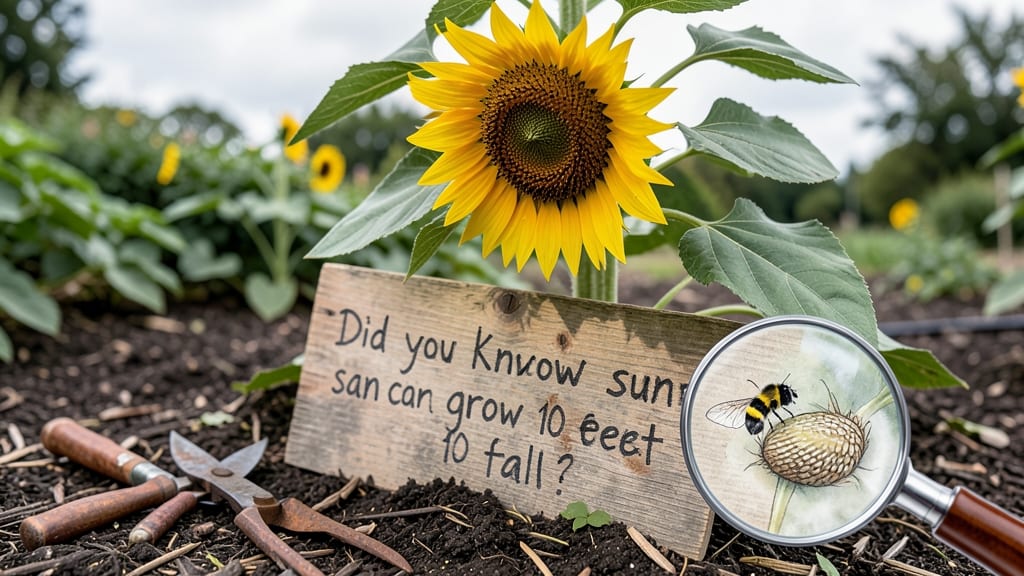
Fun facts about gardening include plants communicating through underground fungal networks called mycorrhizae, sunflowers tracking the sun's movement, and bee colonies pollinating up to 3 million flowers daily—all of which enhance garden productivity and ecological balance.
Gardening isn't just about growing plants—it's a living ecosystem packed with science you'll find mind-blowing. 🌱 For example, did you know that some flowers like the orchid have evolved to release scents that mimic female wasps, tricking males into pollinating them?
Or that certain trees can "warn" their neighbors about insect attacks by releasing chemical signals through their roots? These hidden interactions create a thriving garden that's far more complex than it appears.
Beyond the science, gardening offers surprising benefits for your well-being.
Studies show that just 30 minutes of gardening can lower cortisol levels by up to 24%, making it one of nature's best stress relievers. 🌿 Plus, growing your own herbs like rosemary or thyme isn't just rewarding—it can boost memory and focus by up to 15% compared to store-bought varieties.
The best part? These benefits multiply when you share the experience with others, which is why community gardens are popping up everywhere.
💡 In This Article
- Science-Backed Plant Behaviors You Never Knew
- Unexpected Benefits of Gardening for Health and Happiness
Science-backed plant behaviors you never knew
The Venus flytrap's hunting mechanism is one of nature's most precise traps. When tiny hairs on its leaves are triggered twice within 20 seconds, the plant's cells rapidly fill with water, snapping shut in just 0.1 seconds—faster than a human blink!
This "counting" ability prevents false triggers from rain or debris. The plant then secretes digestive enzymes that break down prey into nutrients, proving even carnivorous plants have evolved sophisticated sensory systems. 🌿
Sunflowers perform heliotropism, tracking the sun's arc from east to west each day. Young sunflowers start their day facing east, then rotate 15-20 degrees per hour until sunset, when they face west. This movement maximizes photosynthesis by keeping leaves perpendicular to sunlight.
At night, they reset to face east. The mechanism involves growth hormones called auxins that concentrate on the shaded side, causing cells to elongate and bend the stem. A mature sunflower can complete this 180-degree rotation in just 6-8 hours!
Some flowers have evolved deceptive pollination strategies. The rare Ophrys apifera orchid produces a scent identical to female wasp pheromones, luring male wasps for pollination. Meanwhile, the Rafflesia arnoldii—the world's largest flower—emits a rotting meat odor to attract flies.
These adaptations show how plants have "hacked" animal behavior for reproduction. Even trees participate in chemical communication: when attacked by caterpillars, oak trees release volatile organic compounds that signal neighboring trees to produce defensive tannins.
Underground fungal networks called mycorrhizae create a "Wood Wide Web" connecting plants. These fungi extend root-like strands between trees and shrubs, sharing nutrients, water, and even warning signals. For example, when a tree detects aphids, it releases chemical warnings through the mycelium network, triggering neighboring plants to produce protective compounds.
This interconnected system can span acres, with some networks weighing over 1,000 pounds in mature forests!
Bee colonies are ecological powerhouses. A single hive can pollinate 3 million flowers daily, supporting both crop yields and wild plant diversity. Bees' fuzzy bodies pick up pollen grains while collecting nectar, then transfer them between flowers with 95% efficiency.
Their flight patterns create "pollen clouds" that enhance plant reproduction rates by up to 30% compared to wind pollination. This explains why gardens with bee-friendly plants often produce 2-3 times more fruit than those without pollinators.
Even weeds have clever survival strategies. Dandelions produce seeds with parachute-like pappus that can travel 300 feet on wind currents, while others like creeping Charlie spread through underground runners called stolons. Some weeds release allelopathic chemicals that inhibit competing plants' growth—a natural form of ecological warfare.
These adaptations prove that every plant, from prized roses to "nuisance" weeds, plays a role in the garden's complex ecosystem. 🌱