
Size
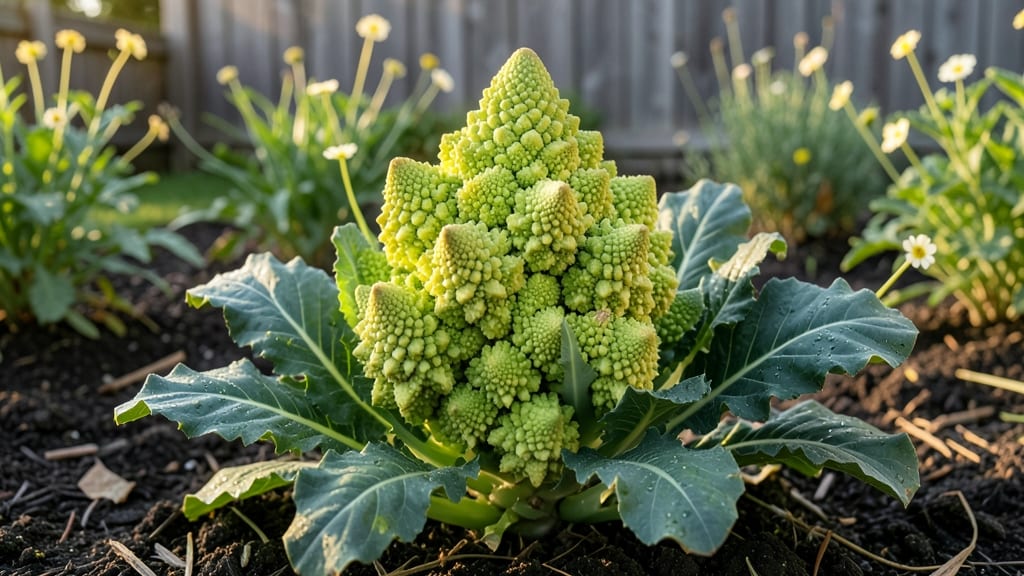
Yes, romanesco grows back in a garden after harvesting its main head, though its regrowth follows a biennial cycle with diminishing yields over time. The plant produces edible heads in its first year and flowering stalks in the second year.
Romanesco's ability to regrow stems from its biennial nature, where it allocates energy differently each year. 🌱 In the first season, it focuses on building the iconic fractal head, while the second year shifts toward flowering.
After harvesting the main head, side shoots may emerge, but these are usually smaller and less abundant. Proper care—like consistent moisture and balanced nutrients—helps stimulate regrowth, though most gardeners find the second harvest less productive.
Varieties like 'Green Romanesco' tend to regrow slightly better than others, making them a practical choice for repeated harvests.
To maximize regrowth, avoid cutting the plant too aggressively, as this stresses the root system. Instead, harvest only the main head and leave the lower stems intact to encourage new shoots. 💫 Cold-hardy varieties perform better in cooler climates, while tender types may struggle in frost.
With the right conditions, you can coax a few more harvests, but expect the quality to decline after the first year.
💡 In This Article
- Romanesco Growth Cycle: Why It Returns (But Not Indefinitely)
- Maximizing Romanesco Regrowth: Pruning and Care Tips
Romanesco growth cycle: why it returns (but not indefinitely)
Romanesco's regrowth ability stems from its biennial life cycle, where energy allocation shifts dramatically between years. In its first year, the plant focuses all resources on developing the distinctive fractal head—those spiraling green-and-white florets that look like mathematical art.
This head is actually a dense cluster of unopened buds, each capable of becoming a flower if the plant survives into its second year. The fractal pattern isn't just decorative; it's a highly efficient way to maximize sunlight exposure for photosynthesis while conserving water.
The plant's energy strategy becomes clear when you examine its second-year behavior. After producing the edible head, romanesco shifts gears entirely, redirecting nutrients toward flowering. This is why you'll often see tall, leafless stalks with yellow blooms in its second season—it's prioritizing reproduction over vegetable production.
Cutting the main head prematurely disrupts this natural cycle, forcing the plant to divert energy toward regrowth instead of flowering, which is why side shoots are typically smaller and less flavorful than the original head. 💫
What most gardeners don't realize is how cutting affects the root system's energy reserves. When you harvest the main head, you're removing the plant's primary photosynthetic surface, which means the remaining leaves must work overtime to sustain both the root system and any potential regrowth.
This creates a competition for resources that explains why second-year regrowth is often sparse. The plant simply doesn't have enough stored energy to produce another full-sized head after the first harvest.
Botanically, romanesco belongs to the Brassica family (like broccoli and cauliflower), which means it shares similar growth patterns. However, its fractal structure makes it unique—each floret follows the Fibonacci sequence (1, 1, 2, 3, 5, etc.), creating that mesmerizing spiral pattern.
This mathematical precision isn't just for show; it's an evolutionary adaptation that optimizes light capture. When you cut the main head, you're essentially removing this light-capturing machinery, which is why regrowth is always less impressive than the original.
Seasonal timing plays a crucial role in regrowth potential. Plants harvested in late summer or early fall have more time to establish new shoots before winter dormancy, while those cut in spring may not have enough growing season left to produce meaningful regrowth.
Cold-hardy varieties like 'Green Romanesco' can better handle these seasonal shifts, while more tender types may struggle to recover after harvesting. The key is understanding that each regrowth attempt draws from a finite energy pool that depletes with each harvest. 🌱
Consider this energy dynamic when planning your garden: while romanesco may return for a second harvest, each subsequent attempt will be progressively smaller and less productive.
This is why many commercial growers treat it as an annual crop—harvesting just the main head and replacing it with new plants for future seasons. The trade-off is between extended regrowth and maintaining plant vigor for optimal flavor and size.