
Diseases
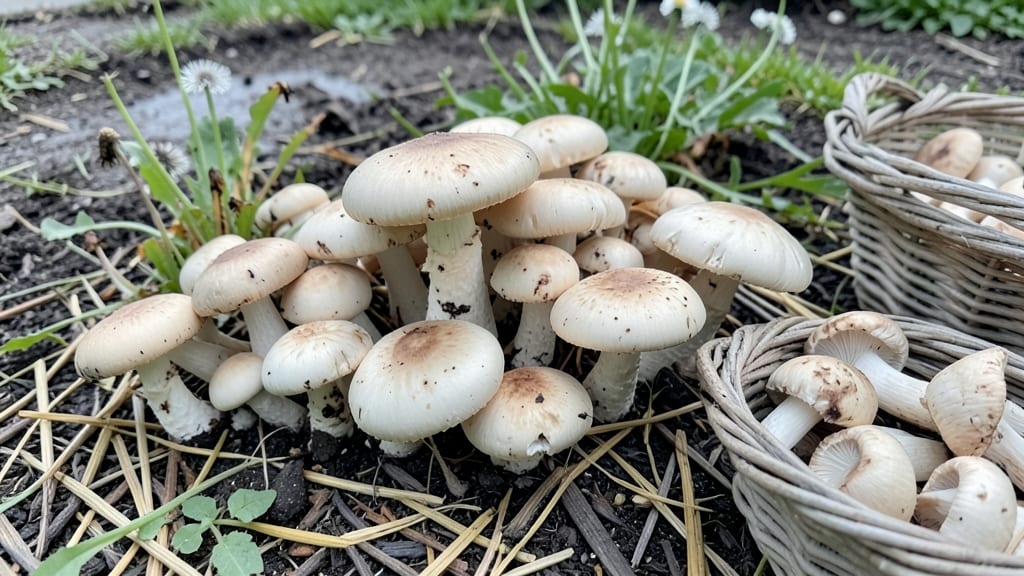
To identify garden mushrooms safely, you need more than just a passing glance—what looks like a delicious snack could be a silent threat lurking in your yard.
Stumbling upon mushrooms in your garden can be thrilling—or terrifying—if you can't tell whether they're a gourmet delicacy or a deadly look-alike. Without proper identification, even a single bite could be fatal, but with the right knowledge, you can safely enjoy the fruits of your garden's fungal bounty.
Most gardeners in Zone 6 spot their first wild 🍄 in spring, when damp soil and mild temperatures trigger a sudden mushroom explosion. The problem? Many poisonous varieties mimic edible ones, and a single misstep can turn a harvest into a hospital visit.
In this guide, I’ll walk you through the key traits to spot with confidence, from cap color to gill patterns, plus the top 5 mushrooms you’re most likely to encounter—and how to tell if they’re safe to eat.
Key features to identify edible garden mushrooms vs poisonous look-alikes
Identifying mushrooms in your garden can feel like solving a puzzle—especially when some species look nearly identical to deadly doppelgängers.
I always start by examining the cap shape, gill color, and stem texture, as these traits often reveal whether a mushroom is safe to eat or a dangerous imposter.
For example, the morel (Morchella esculenta) has a honeycomb cap, while the false morel (Gyromitra spp.) mimics its shape but contains toxic gyromitrin. These visual clues are your first line of defense.
One of the most critical tools for identification is the spore print, which can instantly differentiate species. Place the cap gill-side down on white paper, cover it, and wait 12 hours.
A white or pink spore print often signals edibility (like oyster mushrooms), while a brown or black print may indicate toxicity (like the death cap, Amanita phalloides). I’ve made spore prints for every mysterious mushroom I’ve found—it’s a game-changer for accuracy.
Here’s a quick breakdown of the top 5 visual traits to compare: cap shape, gill attachment, stem characteristics, spore color, and habitat. These features are non-negotiable when distinguishing between edible favorites like shiitake (Lentinula edodes) and their deadly look-alikes.
Let’s dive into the details with a side-by-side comparison to keep you safe.
| Trait | Edible Mushroom (Example) | Poisonous Look-Alike | Key Difference |
|---|---|---|---|
| Cap Shape | Oyster (Pleurotus ostreatus): Fan-shaped | Jack-O'-Lantern (Omphalotus illudens): Orange, convex | Oyster caps are shelflike; Jack-O'-Lanterns are rounded and glowing. |
| Gill Color | Morel (Morchella esculenta): White to cream | False Morel (Gyromitra spp.): Rusty-brown | Morels have honeycomb ridges; false morels are wrinkled and brown. |
| Stem Texture | Chanterelle (Cantharellus cibarius): Smooth, firm | Jack-O'-Lantern (Omphalotus illudens): Fibrous, brittle | Chanterelles have forked, vein-like gills; Jack-O'-Lanterns have true gills. |
| Spore Print | Shiitake (Lentinula edodes): Brown | Death Cap (Amanita phalloides): White | Shiitake prints are brownish; death cap prints are pure white. |
| Habitat | Oyster: Decaying wood, logs | Destroying Angel (Amanita bisporigera): Grass near oak trees | Oysters grow on wood; angels grow in grass near trees. |
The cap shape is often the first clue I check. For instance, the chanterelle (Cantharellus cibarius) has a funnel-shaped cap with false gills that look like ridges, while the jack-o'-lantern (Omphalotus illudens) has a convex, orange cap with true gills.
This distinction is critical—chanterelles are prized for their nutty flavor, while jack-o'-lanterns are bioluminescent and toxic. Always cross-reference with a field guide or app like iNaturalist to double-check.
Next, pay attention to gill attachment. Edible mushrooms like shiitake have decurrent gills (extending down the stem), while poisonous species such as the death cap (Amanita phalloides) have free gills (not attached to the stem).
I’ve seen beginners confuse these—always remember, gill attachment is a game-changer for safety. If in doubt, avoid eating it.
Don’t overlook the stem texture and ring (if present). The shiitake has a short, thick stem with a partial veil ring, while the destroying angel (Amanita bisporigera) has a sack-like volva at the base.
These details can mean the difference between a delicious meal and a medical emergency. I keep a magnifying glass handy to inspect
Top 5 common garden mushrooms you should know (with safety warnings)
Discovering mushrooms in your garden can spark excitement—especially if you're hoping for edible varieties like shiitake or chanterelles. But without proper knowledge, you might mistake a gourmet delicacy for a deadly look-alike.
I’ve grown both cultivated and wild mushrooms for years, and I can’t stress enough how important it is to know the key differences before harvesting anything. Even experienced foragers make mistakes, so let’s break down the top 5 garden mushrooms you’re most likely to encounter.
Before diving into specifics, remember: never eat a mushroom unless you’re 100% certain of its identity. Some species, like the death cap, contain toxins that can be fatal within days. Always cross-reference with a field guide or consult a local mycologist if you’re unsure.
Now, let’s explore the safest and most rewarding mushrooms you might find in your garden beds, logs, or compost piles.
How to Identify Garden Mushrooms: Quick Guide
✅ Check the cap shape (convex, flat, or funnel)
✅ Observe gill color and spacing (close vs. distant)
✅ Note the stem texture (fibrous, smooth, or hollow)
✅ Look for spore prints (use a paper plate under the cap)
✅ Cross-reference with local field guides
❌ Rely on smell alone (some deadly mushrooms smell pleasant)
❌ Assume size determines safety (tiny mushrooms can be toxic)
❌ Eat mushrooms raw or uncooked (some toxins are heat-resistant)
❌ Harvest near roads or industrial areas (contaminants risk)
❌ Forget to document location (for future reference)
"When in doubt, throw it out—your life isn’t worth the risk."
Let’s start with the chanterelle, one of the most prized wild edibles you’ll find in deciduous forests or garden beds with leaf litter. These golden-yellow mushrooms have forked gills that look more like ridges, and they smell like apricots.
Their funnel-shaped cap and thick, off-white stem make them easy to spot—but beware of the false chanterelle, which has true gills and a bitter taste. Always do a taste test on a small piece (cooked) to confirm safety.
The shiitake is another garden favorite, often grown on hardwood logs or sterilized sawdust blocks. You’ll recognize them by their dark brown caps with concentric rings and thick, off-white stems. Shiitakes are cultivated for their umami-rich flavor, but their wild cousins can be tricky to identify.
Avoid any shiitake look-alikes with white gills or a powdery spore print, as these could be poisonous doppelgängers like the jack-o’-lantern mushroom.
Morels are the holy grail of foraging, with their honeycomb-like caps and conical shape. However, false morels (like the gyromitra) are highly toxic and can cause seizures or death. Always check for a true honeycomb pattern and avoid any morel with a wrinkled or brain-like cap.
If you’re growing morels at home, use sterilized hardwood sawdust and maintain high humidity to encourage safe fruiting.
Oyster mushrooms are easy to cultivate and thrive on straw, coffee grounds, or hardwood chips. Their fan-shaped caps and pale pink to white gills make them unmistakable. But watch out for the deadly webcap, which has similar shapes but toxic properties.
Always harvest oyster mushrooms when their caps are still curled and their gills are tightly packed—this ensures the best flavor and texture.
Lastly, the lion’s mane is a delicious and medicinal mushroom with a shaggy, white, pom-pom appearance. It grows on dead hardwood trees or can be cultivated on sawdust blocks. While generally safe, some people experience allergic reactions, so introduce it to your diet slowly.
Avoid any lion’s mane look-alikes with yellowing caps or black spots, as these could indicate contamination or toxicity.