
Watering
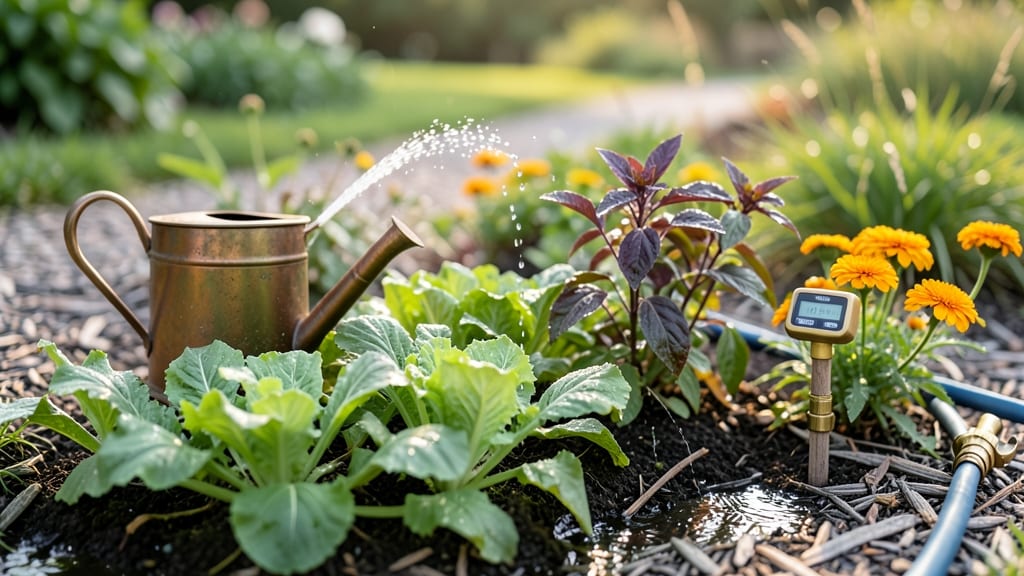
To determine how long to water your garden, consider your soil type: sandy soil needs 5-10 minutes per zone, clay holds moisture for 15-20 minutes, while loamy soil typically requires 10-15 minutes per session. Always check soil moisture before watering deeply.
Your garden's soil type directly impacts how long you should water because different compositions absorb and release moisture at varying rates.
Sandy soil drains quickly, requiring shorter, more frequent watering sessions to prevent runoff, while clay soil retains water longer but may suffocate roots if overwatered. Loamy soil, the ideal balance, holds moisture efficiently, making it the easiest to manage.
I always recommend testing your soil first by digging a small hole—if it feels dry 2 inches down after watering, you need to adjust your duration. 💧
Beyond soil type, plant needs and seasonal conditions play a huge role. For example, vegetables like tomatoes need consistent moisture, so you might extend watering by 2-3 minutes during hot summers. Flowers often prefer slightly drier conditions, while shrubs may need deeper, less frequent watering.
Always observe your plants: wilting leaves or yellowing stems signal you're either over- or under-watering. A simple soil moisture meter can take the guesswork out of timing.
💡 In This Article
- How Soil Composition Affects Watering Time
- Optimal Watering Schedules by Plant Type and Season
How soil composition affects watering time
Soil composition determines how quickly water penetrates and how long it stays available to plant roots. Sandy soil, made up of large particles with big air spaces, drains water like a sieve—water flows through in just 5-10 minutes, leaving roots thirsty.
This is why sandy gardens often need shorter, more frequent watering sessions to prevent moisture from bypassing the root zone entirely. The particles are too coarse to hold water against gravity, so even a 10-minute session may only wet the top 1-2 inches of soil. 💧
At the opposite end, clay soil has tightly packed, minuscule particles that create tiny pores trapping water like a sponge. This retention means clay holds moisture for 15-20 minutes or longer, but the trade-off is poor aeration—roots can suffocate if water doesn't drain.
The key with clay is slower, deeper watering to encourage downward penetration rather than surface pooling. A 15-minute session might only saturate 3-4 inches deep, not the 6-8 inches most plants need for full hydration.
Loamy soil strikes the perfect balance, combining sand, silt, and clay in proportions that allow water to infiltrate steadily while retaining enough moisture for roots. Its crumbly texture creates ideal pore spaces—water moves at a moderate pace, typically requiring 10-15 minutes per session to reach 6 inches deep.
What makes loam special is its ability to "buffer" moisture: after watering, it releases hydration gradually over 24-48 hours, reducing the risk of both drought and waterlogging.
Particle size isn't the only factor—the organic matter content also plays a role. Soils rich in decomposed plant material (like compost) can hold 20-30% more water than mineral-only soils, effectively extending the hydration window.
For example, a sandy loam (60% sand, 30% silt, 10% clay) might need only 8-12 minutes of watering compared to pure sand's 5-10 minutes, thanks to better water-holding capacity. 🌱
Here's a quick comparison of how these soils behave during watering:
- Sandy soil: Water disappears fast (5-10 minutes), needs frequent top-ups, high risk of runoff
- Clay soil: Water lingers (15-20+ minutes), prone to compaction, may develop crust
- Loamy soil: Balanced absorption (10-15 minutes), even moisture distribution, ideal for most plants
The best way to determine your soil's true watering needs is the "percolation test": Dig a 6-inch hole, fill it with water, then time how long it takes to drain completely. This gives you the actual saturation rate for your specific garden conditions. 💡