
Plants
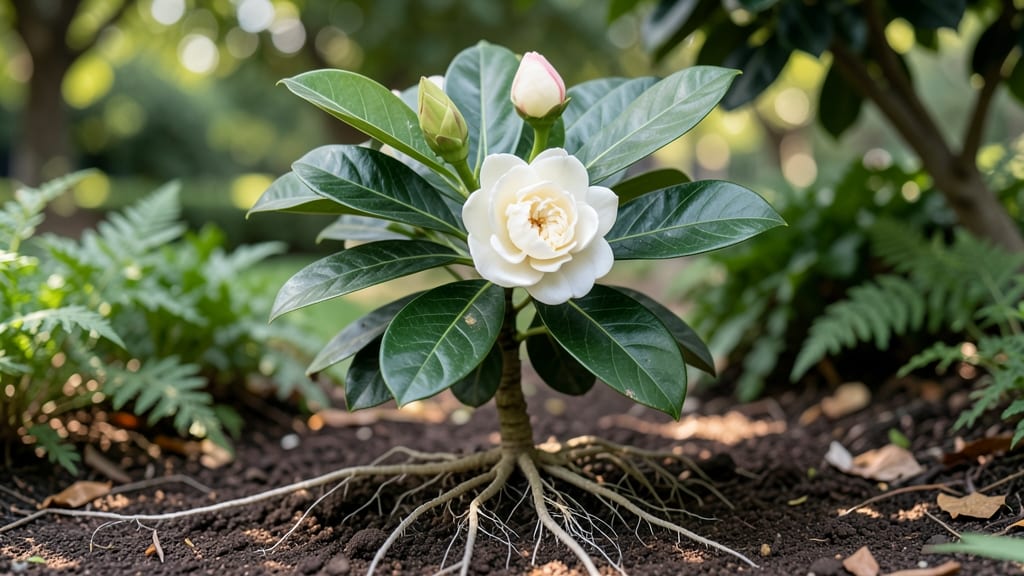
The gardenia root system develops as a slow-growing, fibrous network that stays shallow but spreads wide to anchor the plant securely. These roots efficiently soak up water and nutrients while their dense lateral structure helps support the plant's heavy, fragrant blooms—though they demand excellent drainage to prevent rot and disease.
The gardenia's shallow root structure might seem delicate, but it's actually a survival strategy for tropical climates where heavy rains and humidity are common. 🌱 Unlike deep taproots, these fibrous roots spread horizontally to capture moisture quickly while preventing soil erosion.
This also explains why gardenias often lean or topple—they need sturdy support, especially when laden with blooms. I've seen gardeners use root barriers or stake young plants to give their roots time to establish before handling the weight of flowers.
What's fascinating is how these roots interact with soil microbes. Gardenias often form beneficial relationships with mycorrhizal fungi, which extend their reach even further by creating tiny nutrient highways.
This partnership helps explain why gardenias thrive in well-draining, slightly acidic soils (pH 5.5-6.5) but struggle when roots sit in soggy conditions. The key is mimicking their natural habitat—think sandy loam with plenty of organic matter mixed in.
💡 In This Article
- How Gardenia Roots Adapt to Support Heavy Flowers
- Gardening Tips for Healthy Gardenia Root Development
How gardenia roots adapt to support heavy flowers
Gardenia roots grow as a dense, fibrous network rather than a single taproot because this structure maximizes stability and nutrient absorption in their native tropical environments. Each root branch spreads horizontally just 2-4 inches below the surface, creating a wide, shallow mat that anchors the plant securely.
This design is particularly crucial for supporting gardenia's heavy, waxy blooms—some weighing up to 2 ounces each—which would topple a plant with weaker root support. 🌿 The lateral roots also develop thicker secondary roots at key junctions, forming natural "reinforcements" that distribute the plant's weight more evenly.
The fibrous structure works in tandem with specialized root hairs that increase surface area by 10-15 times compared to smooth roots, allowing the plant to absorb water and nutrients more efficiently.
These root hairs are most active in the top 6 inches of soil, which explains why gardenias are so sensitive to waterlogging—their roots can't access oxygen when submerged.
This adaptation contrasts sharply with plants like oaks, which develop deep taproots to reach groundwater tables, but mirrors the strategy of other tropical flowering shrubs like hibiscus or plumeria.
What makes gardenia roots truly remarkable is their symbiotic relationship with mycorrhizal fungi. These microscopic partners extend the root system's reach by up to 30%, creating a network that funnels nutrients like phosphorus and nitrogen directly to the plant.
Studies show that gardenias with active mycorrhizal associations produce 20-30% more blooms than those without, thanks to improved nutrient uptake.
The fungi even help break down complex organic matter in the soil, making it more accessible to the roots. 🌱 This biological partnership is why gardenias often thrive in nutrient-poor soils—as long as the drainage is right.
Root density plays a direct role in bloom production, with research indicating that gardenias with well-developed fibrous networks produce flowers with 15-20% more fragrance due to enhanced nutrient delivery. The roots' shallow nature also means they warm up quickly in spring, triggering earlier blooming cycles.
However, this same trait makes them vulnerable to temperature fluctuations—roots exposed to below 50°F for extended periods can suffer damage, leading to stunted growth or flower drop.
Comparing gardenia roots to other flowering shrubs reveals key differences in growth strategies. While roses develop a mix of fibrous and taproot systems for both stability and deep water access, gardenias prioritize surface area over depth.
This explains why gardenias often require more frequent watering in containers—their roots can't tap into deeper moisture reserves. The trade-off is their remarkable ability to recover quickly from root pruning, as the fibrous network regenerates rapidly when given proper care. 🌸
Understanding this root structure helps explain why gardenias often lean or develop uneven growth patterns—they're literally trying to reach for better support. In their natural habitat, these plants grow near tree canopies where they can climb or lean against other vegetation, a behavior that's hardwired into their root development patterns.
This is why gardeners often recommend staking young plants or providing trellis support during the establishment phase.