
Container Gardens
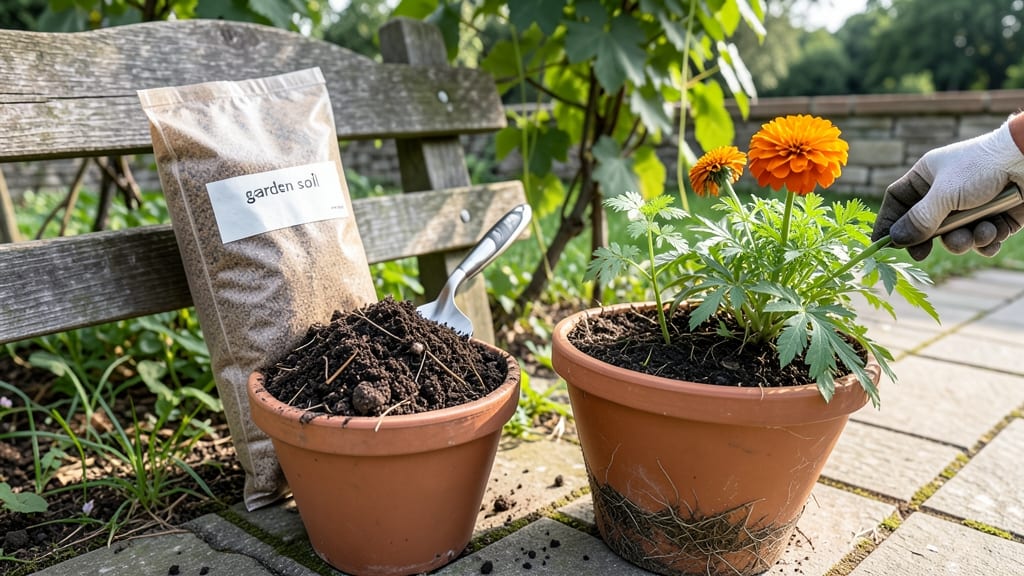
You can use garden soil in pots, but only when mixed with perlite, sand, or compost (25-30% ratio) to prevent root suffocation and improve drainage. Pure garden soil compacts easily, traps moisture, and lacks the nutrients container plants need. Avoid heavy clay soil entirely.
Garden soil works best in pots when you transform it into a lightweight blend. 🌱 The problem with straight garden soil is its density—it becomes compacted in containers, cutting off oxygen to roots and trapping excess moisture, which leads to rot.
For container plants, I recommend blending garden soil with 25-30% perlite or vermiculite to create air pockets, plus a handful of compost to replenish nutrients lost during mixing. This approach mimics the natural looseness of forest soil while keeping your plants thriving.
Different plants need different adjustments. Herbs and succulents benefit most from this mix because they hate soggy roots, while leafy greens or tomatoes can tolerate slightly richer blends with added worm castings.
The key is testing your mix: if water pools on top after 10 minutes, you need more sand or perlite. For heavy clay soil, skip it entirely—it's too dense even with amendments.
💡 In This Article
- Why Garden Soil Fails in Container Gardening
- Best Soil Mixes for Pots Using Garden Soil
Why garden soil fails in container gardening
Garden soil is designed for in-ground planting where roots can spread freely and natural compaction occurs over time. But in pots, the confined space creates a completely different environment.
When you pack garden soil into containers, its natural particles—silt, sand, and clay—compress tightly, reducing pore space by up to 40%. This suffocates roots by cutting off oxygen, which is crucial for respiration.
Healthy roots need 10-30% air space in their growing medium, but compacted soil often drops below 5%, stunting growth and inviting fungal diseases like root rot.
The moisture dynamics change dramatically too. In-ground soil drains vertically through layers of subsoil, but pots have nowhere for excess water to escape. Garden soil holds 2-3 times more water than ideal potting mixes, creating a soggy environment where roots drown.
This is why plants in unamended garden soil often wilt despite "wet" looking soil—it's actually waterlogged, blocking oxygen and nutrients. The texture difference is stark: garden soil feels dense and clay-like when dry, while good potting soil crumbles easily and feels airy.
Nutrient availability also suffers. Garden soil's organic matter breaks down slowly over years, while container plants exhaust nutrients in weeks. The microbial activity that replenishes nutrients in natural soil can't keep up with the rapid growth demands of potted plants.
For example, a basil plant in garden soil might show yellowing leaves within 3-4 weeks as nitrogen becomes depleted, while the same plant in a well-amended mix thrives for months. The pH balance shifts too—garden soil often sits at 6.0-7.5, but container plants prefer 5.5-6.5 for optimal nutrient uptake.
Clay soil presents the worst case scenario. Its microscopic plate-like particles pack together like a brick wall when wet, creating a near-impermeable barrier. Even with amendments, clay soil's natural 10-20% shrinkage when dry creates gaps that fill with air, but these gaps collapse when watered, recreating the suffocation problem.
The solution isn't just adding sand—it's restructuring the entire soil architecture to create stable air pockets through organic matter and mineral additives.
What most gardeners miss is how the root zone temperature changes. Pots heat up faster than ground soil, especially in clay containers, while garden soil's high moisture content creates a cooler microclimate.
This temperature swing stresses roots already struggling for oxygen. The fix? Amendments like perlite not only improve aeration but also moderate temperature fluctuations by 5-10°F during heat spikes. 🌡️
Consider this comparison: in-ground soil has 10-15% organic matter over time, while a typical potting mix needs 20-30% organic matter to compensate for the lack of natural soil structure. That's why even "good" garden soil often fails in containers—it's simply not engineered for the confined, high-demand environment of potted plants.