
Tools
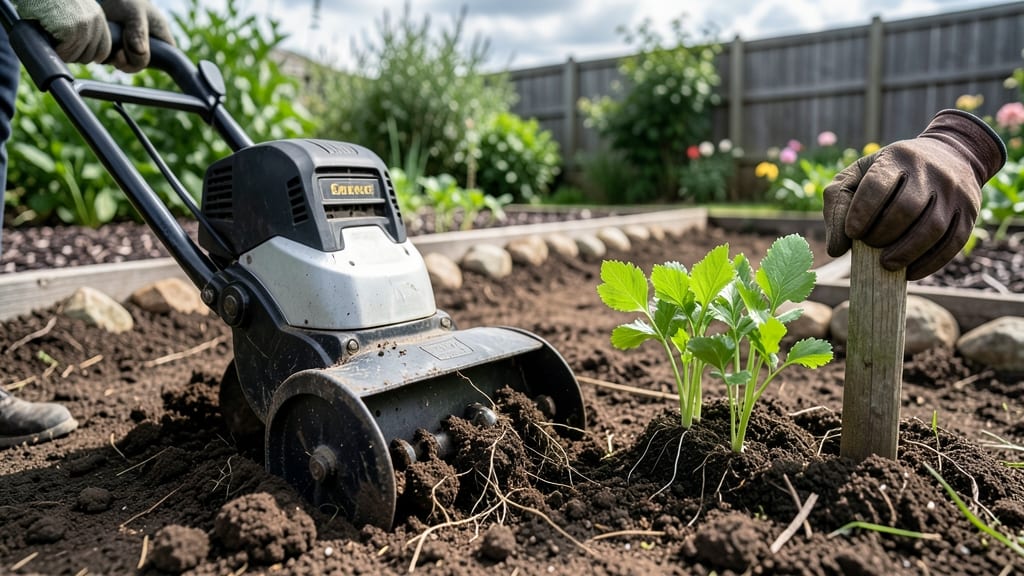
The best garden rotary tillers for heavy soil deliver high torque and durable construction to efficiently break through compacted clay while preserving soil health. Prioritize models with at least 6 horsepower, adjustable tilling depth, and rear-wheel drive for maximum control and performance.
Heavy clay soil demands a tiller with serious muscle—think of it as a heavy-duty excavator for your garden. 🔥 The right machine needs 6+ horsepower to slice through stubborn clay without bogging down, while deep tilling blades (often 6-8 inches) ensure you're not just scratching the surface.
Rear-wheel drive models distribute power more effectively, preventing the tiller from getting stuck mid-task. I've found that gear-driven transmissions outperform belt-driven ones for clay gardens, offering better torque control at lower speeds.
Don't overlook blade design either—tine blades (vertical) work well for initial breaking, while disc blades (horizontal) help mix in amendments like compost. Many premium models now include adjustable depth settings, letting you fine-tune based on soil conditions.
For example, Troy-Bilt's Briggs & Stratton engines consistently deliver reliable power, while Husqvarna's gear-drive systems handle wet clay better than competitors.
💡 In This Article
- How Rotary Tillers Work for Heavy Clay Soil
- Top Rotary Tiller Features for Clay Soil Gardens
How rotary tillers work for heavy clay soil
Rotary tillers tackle heavy clay through a combination of brute force and smart engineering. The engine's torque—measured in foot-pounds—is what actually shatters clay's dense molecular structure.
For example, a 6.5 HP engine generates about 20-25 ft-lbs of torque, while 8+ HP models can push 30 ft-lbs or more, making the difference between struggling and effortlessly breaking up 3-4 inch deep compacted layers.
The blades rotate at 150-250 RPM, creating a shearing action that fractures clay particles without pulverizing them into dust.
Blade design plays a crucial role in how effectively the tiller handles clay. Vertical tine blades (like those on Troy-Bilt's PowerSmart series) create a "plowing" motion that lifts and breaks clay in chunks, while horizontal disc blades (found on Husqvarna's models) provide more surface area contact for finer soil mixing.
The best systems combine both—starting with tines to break up large clods, then using discs to incorporate amendments. What's fascinating is how the blade angle affects performance: blades set at 30-45 degrees cut more efficiently through clay than flat blades, which tend to push soil sideways rather than lift it.
Transmission type determines how that power gets delivered to the blades. Gear-driven transmissions (like those in Earthwise's CT1000) offer better torque multiplication at lower speeds, making them ideal for clay where you need controlled force.
Belt-driven systems (common in budget models) provide smoother operation but struggle with heavy loads—they can slip under 15-20 ft-lbs of resistance, causing the tiller to "walk" backward.
This is why rear-wheel drive configurations distribute power more evenly: the 12-15 inch wide rear wheels provide traction while the front wheels stay lighter for maneuverability.
Here's what happens under the hood when you engage the tiller: The engine's flywheel spins the transmission, which then rotates the tilling blades in the opposite direction.
In clay soil, the resistance creates a backpressure effect that actually increases torque by up to 20%—this is why tillers feel easier to push when the soil is compacted.
However, this same mechanism can cause overheating if you push too hard, so most quality models include overload protection clutches that disengage when torque exceeds 35-40 ft-lbs to prevent engine strain.
Consider this real-world example: When breaking up 100 square feet of 2-inch deep compacted clay, a 6.5 HP gear-driven tiller with 6-inch deep blades will complete the job in about 20-25 minutes, while a 5 HP belt-driven model might take 40+ minutes and leave larger clumps.
The difference comes down to how efficiently the machine converts engine power into actual soil disruption. 💫
The science behind why clay is so tough to till lies in its shrink-swell properties. Clay particles (smaller than 0.002 mm) bind tightly with water, creating a dense matrix that can exert pressures up to 1,000 psi when dry.
A rotary tiller's blades need to overcome this pressure while maintaining 1-2 inch blade spacing to prevent clogging. This is why tillers designed for clay often feature heavy-duty steel blades with hardened tips that can withstand the abrasive nature of clay particles without dulling quickly.