
How To
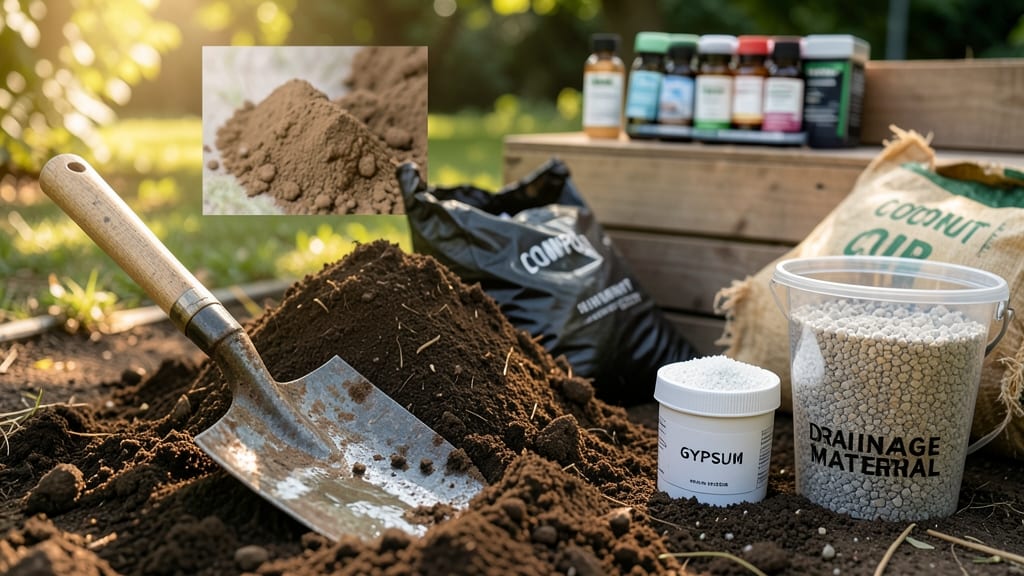
To fix clay soil for gardening, incorporate organic matter like compost or aged manure, mix in sand or perlite for better drainage, and avoid walking on garden beds to prevent compaction. Always check soil pH and adjust with lime or sulfur for healthier plant growth.
Clay soil's dense, sticky nature makes it challenging for roots to spread and water to drain properly.
The key is breaking up that compacted structure—organic matter like compost or leaf mold acts like a sponge, improving aeration and water retention while feeding beneficial microbes. 🌱 For drainage, I've found coarse sand or perlite works best when tilled in, but avoid heavy foot traffic since clay compacts easily under pressure.
Testing your soil's pH first helps determine whether you need to add lime (to raise pH) or sulfur (to lower it) before amending.
Start the improvement process in fall when soil is moist but not frozen, giving amendments time to integrate before planting season. A broadfork or rototiller makes the job easier, but for smaller gardens, a sturdy shovel and elbow grease work too.
I like to layer compost 2-3 inches deep before tilling, then top with 1-2 inches of sand for that extra drainage boost. Over time, these changes create a looser, more fertile growing medium that supports stronger root systems and healthier plants.
💡 In This Article
- Why Clay Soil Struggles and How Organic Amendments Help
- Step-by-Step Clay Soil Improvement Guide for Garden Beds
Why clay soil struggles and how organic amendments help
Clay soil's tiny, tightly packed particles create a dense matrix that traps water and air, making it nearly impossible for roots to penetrate. When wet, it turns into a sticky mess that suffocates plant roots, while dry clay becomes as hard as concrete.
The problem lies in its high plasticity—clay particles have negative charges that attract and hold onto water molecules, reducing pore space by up to 40-50% compared to sandy soil. This lack of aeration forces roots to struggle for oxygen, stunting growth and making nutrient uptake inefficient. 🌧️
Organic amendments like compost or aged manure work by introducing fibrous materials that physically break up clay's compacted structure. Think of it like adding straw to wet cement—it creates air pockets and improves drainage while retaining moisture.
Compost's microbial activity also produces glomalin, a sticky glycoprotein that binds soil particles into stable aggregates, increasing porosity by 20-30%. Peat moss adds a similar effect with its high water-holding capacity (5-10 times its weight), while coconut coir provides excellent aeration due to its fibrous, sponge-like texture.
For drainage issues, gypsum (calcium sulfate) is particularly effective in clay soils because it replaces sodium ions with calcium, reducing soil dispersion and improving structure without altering pH. Sand is helpful but must be coarse (0.5mm particle size) to prevent creating a "concrete-like" mixture when mixed with clay.
Perlite or vermiculite works better for long-term aeration since they remain porous even after settling. The key is balancing these amendments—too much sand can make soil too loose, while too much organic matter can create a gummy texture. 🧪
What most gardeners overlook is the role of soil biology. Healthy clay soil should teem with earthworms, fungi, and bacteria that break down organic matter and create tunnels for roots.
A simple test: dig a 6-inch deep hole—if you see fewer than 5-10 worms per square foot, your soil needs more organic input. These creatures aerate the soil naturally, reducing the need for mechanical tilling which can actually worsen compaction in the long run.
Consider this comparison: untreated clay soil has a water infiltration rate of just 0.1 inches per hour, while amended clay can reach 1-2 inches per hour—a 10x improvement. This dramatic change explains why plants thrive once the soil structure is improved.
The organic matter doesn't just loosen the soil; it creates a living ecosystem where roots can explore freely and microbes work to break down nutrients into plant-available forms. 🌱