
Advice
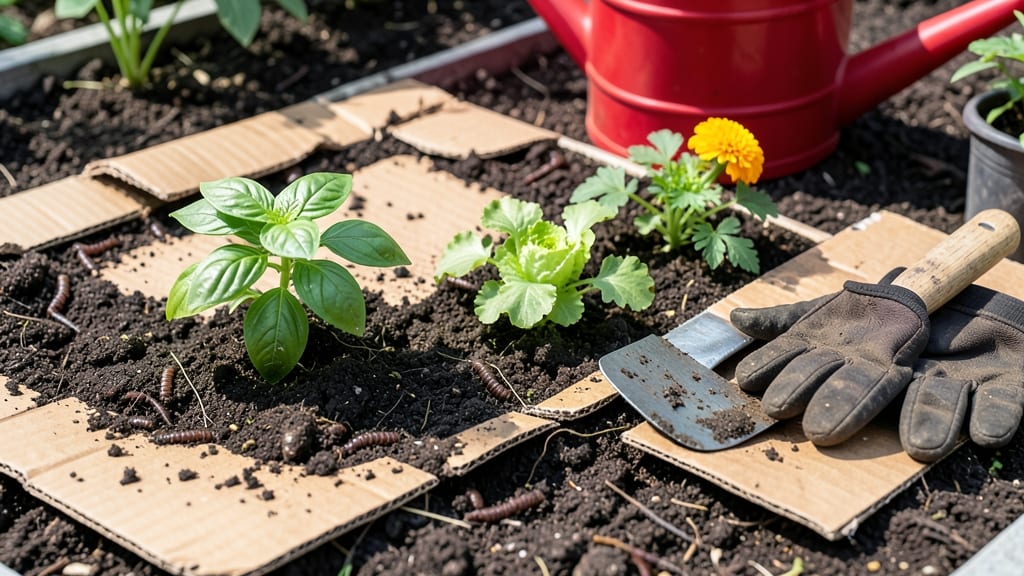
You can use cardboard in your garden safely when it's unbleached and free of tape or staples, as it decomposes into nutrient-rich mulch, blocks weeds, and helps retain soil moisture. Just avoid treated or glossy cardboard to prevent harmful chemicals from leaching into your plants.
Cardboard's cellulose-rich composition makes it an excellent organic mulch when prepared correctly. 🌱 Microbes in the soil break it down over time, gradually releasing nutrients—though it lacks nitrogen, pairing it with nitrogen-rich materials like grass clippings speeds up decomposition.
Unlike synthetic mulches, it won't degrade into microplastics, making it an eco-friendly choice for gardeners who want to reduce waste while improving soil health.
For best results, lay the cardboard flat with the print side down (to prevent ink from leaching) and cover it with 2-3 inches of compost or mulch. This setup suppresses weeds, retains moisture, and eventually becomes part of your soil's structure.
Just remember: never use cardboard with glossy finishes or tape—these contain chemicals that can harm your plants.
💡 In This Article
- How Cardboard Breaks Down in Garden Soil
- Safe Cardboard Preparation for Garden Beds
How cardboard breaks down in garden soil
Cardboard's decomposition starts with its cellulose structure—about 90% of its composition—which microbes in the soil love to feast on. When buried or covered with mulch, these microbes break down the fibers into simpler compounds, releasing carbon dioxide and water as byproducts.
This process is similar to how leaves or straw decompose, but cardboard's dense fibers take slightly longer—typically 3-6 months to fully break down, depending on climate and soil conditions.
The key challenge is nitrogen depletion. Cardboard has a high carbon-to-nitrogen ratio (C:N ratio of 80:1 or higher), which can temporarily "starve" soil microbes. This is why gardeners often pair it with nitrogen-rich materials like grass clippings or manure.
Without this boost, decomposition slows dramatically, and you might notice a temporary odor as microbes compete for limited nitrogen. In contrast, straw (with a C:N ratio of 80:1 to 100:1) behaves similarly, but leaves (around 60:1) decompose faster due to their higher nitrogen content.
As cardboard decomposes, it gradually improves soil structure by adding organic matter that enhances water retention and aeration. The breakdown process also creates tiny air pockets, which helps roots penetrate more easily. Unlike synthetic mulches, cardboard doesn't release microplastics—it simply becomes part of the soil ecosystem.
For example, in a study by the University of California, researchers found that cardboard mulch increased soil organic matter by 15-20% over a growing season when paired with nitrogen sources.
One visual clue that decomposition is underway is the cardboard's texture—it softens and becomes spongy as microbes colonize it. Initially, you might see mold growth on the surface, but this is normal and harmless when covered properly.
Over time, the cardboard transforms into a dark, crumbly mulch that blends seamlessly with the soil. This natural process makes cardboard an excellent choice for gardeners who want a low-cost, sustainable way to enrich their soil without synthetic additives.
For comparison, straw breaks down in 1-2 months but lacks the weed suppression benefits of cardboard, while leaves decompose in 2-4 months but can compact soil if used alone. Cardboard strikes a balance—it's durable enough to block weeds for months while still contributing to long-term soil health.
The trade-off? It requires proper preparation to avoid pests or mold, which we'll cover in the next section.
What most people don't realize is that the ink on plain cardboard (not glossy) is usually plant-based and breaks down safely. However, the real risk comes from staples or tape—these can introduce metals or adhesives that harm soil microbes. Always remove these before using cardboard in your garden beds. ✨